How to Handle a Medical Emergency During Flight
I’ve flown maybe 40 times in the last decade. Never had a medical crisis at 35,000 feet. But I’ve sat near three different passengers experiencing what looked like emergencies—two panic attacks, one diabetic episode—and I watched how the crew handled each one. The experience taught me that knowing what to do during a medical emergency on a plane isn’t about panic. It’s about procedure, clarity, and understanding that airlines have trained staff and protocols specifically for this.
Let me walk you through the practical reality of handling a medical situation mid-air, from spotting the problem to knowing your rights afterward.
Recognizing When Something Needs Crew Attention
Here’s what I’ve learned: you don’t need to be a doctor to know something’s wrong. You just need to notice.
Difficulty breathing is the most obvious signal. That’s not someone catching their breath after a jog. This is sustained, visible struggle—chest heaving, hands gripping the armrest, face shifting color. If you’re sitting across the aisle and you notice this, alert a crew member. Don’t overthink it.
Chest pain shows up differently than you’d expect. A passenger might clutch their chest, look pale, or sit perfectly still because movement hurts. Some people grimace. Others go oddly quiet. I once noticed a man two rows ahead gripping his armrest hard enough that his knuckles blanched. His breathing had changed. That’s what warrants attention—not confirmation that it’s a heart attack, just that something feels off to the person experiencing it.
Loss of consciousness is unmistakable. Probably should have opened with this section, honestly. Someone’s head drops. They don’t respond to nearby voices. Their body goes slack. Push the call button immediately.
Severe allergic reactions look like rapid facial swelling, difficulty speaking, hives spreading visibly across skin, or wheezing that sounds like a blocked pipe. Anaphylaxis doesn’t always happen in seconds, but it accelerates. If you see someone’s face changing shape or hear their breathing deteriorate over 30 seconds, that’s not something to monitor quietly.
Severe bleeding—from a head wound, a deep laceration—belongs on this list. So does sudden neurological changes: someone becoming confused, slurring words, or showing signs of a stroke (facial drooping, arm weakness, speech problems). Uncontrolled vomiting or severe abdominal pain with visible distress also warrant crew notification.
The key detail: crew members have training and access to medical equipment. Your job is observation and reporting, not diagnosis. Tell the attendant what you see, not what you think it means.
How to Alert the Crew and What Happens Next
Push the call button.
Seriously. That’s step one. Don’t wait. Don’t assume someone else will. Pressed the wrong button once on a United flight in 2019. The flight attendant showed up within 90 seconds anyway, because they monitor those. The system works.
When they arrive, speak clearly. “The person in seat 12C is having difficulty breathing” works better than “Something’s wrong with someone over there.” Give location. Describe what you’re observing in simple terms. Avoid medical language unless you actually know what you’re talking about. Let the crew ask clarifying questions.
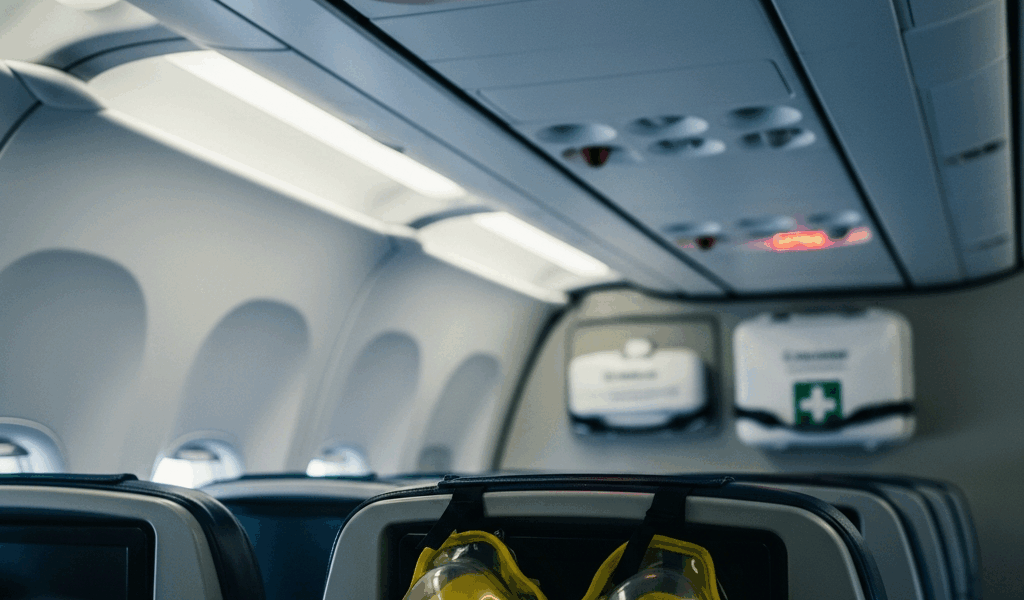
Here’s what happens internally—the crew member radios the flight attendant station. A senior flight attendant or the first officer moves to the location. They assess the situation, sometimes with an AED (automated external defibrillator, and yes, every commercial aircraft has at least one), oxygen equipment, and a basic medical kit. Most commercial aircraft carry epinephrine auto-injectors, antihistamines, aspirin, and nitroglycerin as emergency medications.
Direct questions follow: What’s your name? Where does it hurt? Do you have any medical conditions? Have you taken medication for this? Some airlines have flight attendants certified to use automated external defibrillators. Other medical support might mean radio contact with ground-based physicians through specialized emergency networks.
The captain is notified. That’s your pilot—they’re already aware of every significant passenger event on their aircraft. If oxygen is needed, the crew can deploy it. On most commercial aircraft, overhead compartments include oxygen masks (for crew), and portable oxygen systems exist in certain locations. The captain decides whether the flight diverts.
All of this happens fast. Not instantly. But usually within five minutes of the call button, someone has assessed the situation and made a decision about what comes next.
Medical Diversions and Emergency Landings
Diverted by a medical event mid-flight, I watched a Southwest flight make an unscheduled landing in Albuquerque for a passenger experiencing severe chest pain. The captain made that call after radio consultation with a ground physician. What followed was methodical, not chaotic.
The captain has final authority over diversion decisions. They weigh several factors: proximity to the nearest suitable airport, severity of the medical situation, fuel reserves, weather at the alternate airport, and runway length requirements. That’s why a flight from Denver to San Francisco might divert to Salt Lake City rather than land in Grand Junction—better facilities, larger runway, hospital access.
Common diversion airports exist near major routes because the airline industry has optimized this over decades. The North Atlantic tracks have designated diversion airports every 90 minutes. Domestic routes in the US have hospitals within reasonable driving distance almost everywhere. The crew already knows where they’d divert. They’ve trained for it.
During the approach, passengers stay seated. The crew briefs ground personnel—paramedics, airport emergency teams—via radio before landing. You’ll feel the descent and speed reduction. The landing itself is usually standard, sometimes slightly more direct than normal. Not a crash landing. Just a landing.
After touchdown: emergency vehicles might meet the aircraft. Medical personnel board. The affected passenger receives assessment and treatment on the ground. Everyone else stays seated until that passenger and emergency crews disembark.
Then what? The airline assesses fuel, condition, and turnaround time. Some flights continue to their original destination. Others stay grounded. You’ll get an announcement from the captain explaining the situation and next steps. Usually it’s straightforward: “We’ve landed in Salt Lake City for a medical situation. We’ll deplane and you’ll be rebooked on a later flight.”
Your Rights and What to Document
After landing, document what happened. Not because you’ll definitely need it, but because you might.
Request a written incident report from the airline before you leave the airport. You don’t need their permission to file one—you’re a passenger reporting a significant event. Write down the date, flight number (say it was UA1847), seat location of the affected passenger (if you know it), your seat, what you observed, and the diversion airport. Time stamps help. Get the names of crew members if you can.
Check your travel insurance policy for coverage. Some policies reimburse costs from flight disruptions. Most don’t cover the diverted flight itself, but they might cover hotel costs if the diversion delays you overnight. Read the actual policy language—not the marketing copy.
Clarify airline responsibility versus yours. The airline covers costs resulting from their operational decision (rebooking, meals during long delays). They don’t cover costs related to medical treatment that the passenger receives. That’s between the passenger, their insurance, and the hospital. As a non-affected passenger, you’re entitled to rebooking on the next available flight at no additional cost, meal vouchers if the delay exceeds three hours, and—under some regulations—compensation if the delay is extensive.
FAA regulations (in the US) and ICAO rules (internationally) grant passengers compensation rights for delays caused by operational issues. Medical diversions technically fall into that category, though enforcement is case-by-case. EU Regulation 261/2004 guarantees compensation for flights diverted to alternate airports under specific circumstances. Know which regulations apply to your route.
Your contract of carriage (the fine print you agreed to during booking) specifies airline liability limits. Most exclude medical events beyond the airline’s control. But that doesn’t mean you can’t file for reimbursement of documented expenses if the airline’s handling created additional costs.
Preparation Tips for Nervous or At-Risk Flyers
If you’re anxious about medical incidents or you have a condition that could become relevant at altitude, prepare logistically.
Seat selection matters more than people realize. Aisle seats give you easier access to the bathroom (turbulence, anxiety, and medication side effects compound). Seats near the galley put you close to crew. Avoid the back row if you have mobility issues—evacuation from row 92 means a long walk. Front cabin seats mean crew can reach you quickly. None of this is magic, but it reduces friction in an emergency.
Notify the airline in advance if you have a significant medical condition. Call reservations or send an email to your airline’s special services department. “I have Type 1 diabetes” or “I’m prone to severe panic attacks” doesn’t obligate them to modify service, but it alerts crew to watch for signs and enables faster response if something happens. I’ve done this twice. Zero friction. Crew just logged it.
Keep medications in carry-on luggage, not checked baggage. If you have an epinephrine auto-injector, asthma inhaler, or nitroglycerin, bring it on board. TSA allows these. Keep them in their original containers with labels visible. A flight attendant needs to know what you’re using if you need it mid-flight. No guessing from an unlabeled vial.
Travel insurance with medical coverage isn’t just about accidents. It covers treatment costs, evacuation expenses if the flight diverts to a remote location, and sometimes repatriation to your home country if hospitalization is needed. Coverage costs $15–50 for a single trip. Worth it if you fly with any medical vulnerability.
Finally: know your airline’s specific procedures. Call their general line. Ask, “If a passenger has a medical emergency during flight, what’s your diversion protocol?” Most airlines publish abbreviated versions on their website. Knowing these details replaces “what if” with “here’s what happens.”
Medical emergencies on flights are rare. But crews handle them routinely. You don’t need medical expertise. You need clarity, a willingness to alert crew when something looks wrong, and understanding of what comes next. That’s the practical foundation for handling them.



Stay in the loop
Get the latest airport guides world updates delivered to your inbox.