Why Is LAX the Airport Code for Los Angeles?
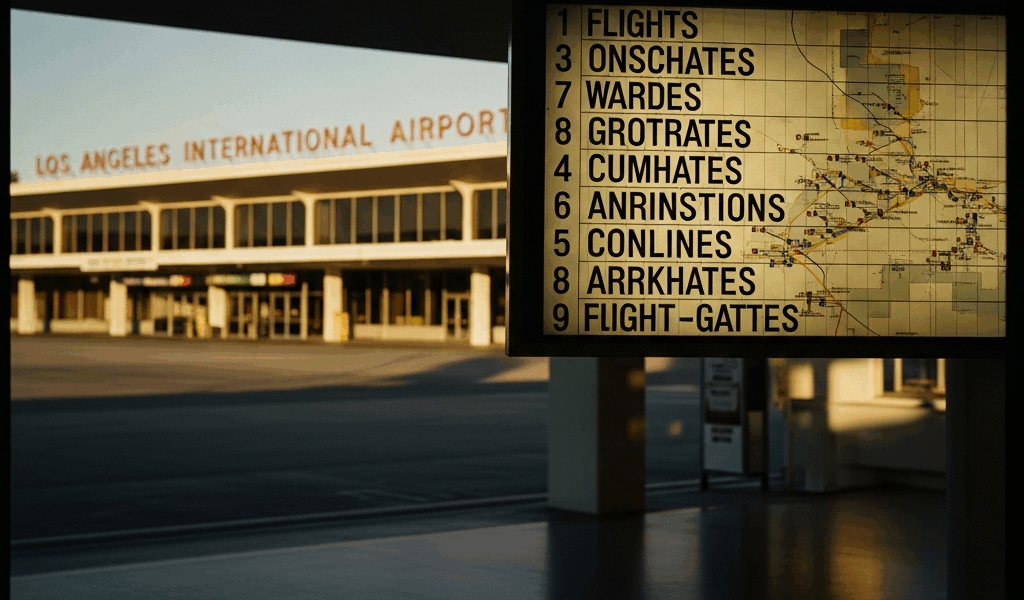
Airport codes have gotten complicated with all the half-true explanations flying around. I’ve wondered about LAX out loud probably a dozen times standing in the Tom Bradley International Terminal — usually while eating a $19 sandwich and staring blankly at the departures board. LAX doesn’t spell anything. It doesn’t stand for anything obvious. And yet here it is, one of the most recognized airport codes on the planet, printed on luggage tags, stamped on boarding passes, and apparently tattooed on the forearms of people who love aviation history more than I probably should admit to understanding. The answer goes back almost a century, and it involves a system overhaul that reshuffled airports across the entire country.
When LA Was Just LA
Before 1947, the United States ran on a two-letter identification system for airports and weather stations. Borrowed directly from the National Weather Service — which had been tagging reporting stations with two-letter codes for decades before commercial aviation was even a real industry — the system made sense at the time. When airports started needing their own identifiers for radio communication, ticketing, and logistics, grabbing from the existing pool was the obvious move.
Los Angeles got LA. Simple. Logical. Probably took about four seconds to decide.
Other cities followed the same pattern. Portland was PD. Phoenix was PH. Chicago used CH. Seattle had SE. Clean, intuitive, worked fine — as long as the number of commercial airports stayed small enough that two letters covered everybody without collision.
But commercial aviation grew fast. Faster than almost anyone predicted in the early 1940s. By the mid-1940s, the International Air Transport Association — the IATA — was staring at a global system trying to run on two letters. Two letters gives you 676 possible combinations. That sounds generous until you’re tagging airports across every continent, accounting for military fields converting to civilian use, regional hubs opening in secondary cities, and international coordination with airports that already had their own naming conventions. The math stopped working.
In 1947, IATA mandated a switch to three-letter codes. Every airport on the system needed a third character. Some got entirely new codes based on their names. Others got a letter stapled to the end of what they already had.
Los Angeles already had LA. The solution was straightforward, if not exactly elegant. Add a third letter.
The X Files — Why X Was Added
Probably should have opened with this section, honestly.
X doesn’t stand for anything in LAX. It’s a filler character — full stop. When airports that already had two-letter codes needed a third letter and their existing abbreviation didn’t naturally suggest one, X got used as a placeholder. A neutral, available character that didn’t conflict with other coding conventions and wasn’t being used systematically by any other identifier at the time.
Los Angeles became LAX. Portland, Oregon — formerly PD — became PDX. Phoenix, which had been PH, became PHX. In every case, the X is doing the same job: occupying the third position because something had to go there, and X was available.
Frustrated by a Wikipedia rabbit hole that handed me six different partial explanations, I spent an afternoon cross-referencing aviation history sources to nail this down. The X-as-filler explanation is documented, consistent, and not actually that complicated — it just rarely gets stated plainly. People want a clever origin story. They want LAX to be an acronym, a tribute, a piece of geographic wordplay. It isn’t. It’s a bureaucratic placeholder that became iconic through sheer repetition and the gravitational pull of a major international airport.
PDX, incidentally, has embraced its X with remarkable civic pride — there’s a whole local brand identity built around it in Portland. LAX gets the same treatment, showing up on hats, t-shirts, and hotel shuttle signage across Los Angeles. The letter that meant nothing became shorthand for an entire city’s relationship with travel.
Don’t make my mistake — I assumed for years that the X indicated something about international status. It does not. That’s a different system entirely — the ICAO four-letter codes used by pilots and air traffic control, where the K prefix indicates airports in the contiguous United States. LAX under ICAO becomes KLAX. The IATA three-letter system and the ICAO four-letter system exist in parallel and serve different audiences. Two separate bureaucracies, two separate logics.
Other Airports That Lost Their Original Codes
The 1947 transition reshuffled a lot of identities. Not every airport got to keep anything resembling its original two-letter tag.
Chicago is the clearest example. Chicago’s original two-letter weather station code was CH — which didn’t naturally extend to anything usable for the city’s main airport. Midway picked up MDW, referencing the airport’s name rather than the city. Then O’Hare opened and received ORD, a code referencing Orchard Field, the old name for the land it was built on. Neither MDW nor ORD looks anything like Chicago or CH. That’s what makes these codes endearing to aviation enthusiasts — every weird abbreviation is a small piece of buried history.
Denver International is DEN, which is clean. Dallas/Fort Worth is DFW, which makes geographic sense. But then you have:
- MCO — Orlando International, formerly McCoy Air Force Base
- MSY — Louis Armstrong New Orleans International, referencing Moisant Stock Yards, where the airport was originally built
- YYZ — Toronto Pearson, following Canada’s Y-prefix convention for airports
- NRT — Tokyo Narita, referencing the city of Narita rather than Tokyo itself
The IATA system, when you actually dig into it, is less a logical naming convention and more an archaeological record. Codes preserve old base names, defunct neighborhoods, colonial-era city names, and administrative decisions made by people who had absolutely no idea their abbreviations would end up printed on a billion luggage tags.
But what the system values above everything else is stability. Once a code is assigned and the logistics infrastructure — ticketing platforms, baggage routing systems, airline databases — builds up around it, changing that code becomes enormously disruptive. MSY survived a full airport rename and a terminal overhaul without the code budging. LAX has outlasted seven terminal renovations, multiple expansions, and decades of proposals to rename the airport entirely.
The three letters stick. Whatever they originally meant — or didn’t mean — they eventually become the thing itself.
Standing at LAX on a Tuesday morning, watching codes scroll past on the arrivals board — SYD, NRT, LHR, CDG — it’s hard not to feel like you’re reading a compressed history of how humans decided to organize the world from the air. LAX is just one entry in that list. But it’s an entry that started as a two-letter placeholder, gained an X that meant nothing, and ended up meaning Los Angeles to the entire world.



Stay in the loop
Get the latest airport guides world updates delivered to your inbox.