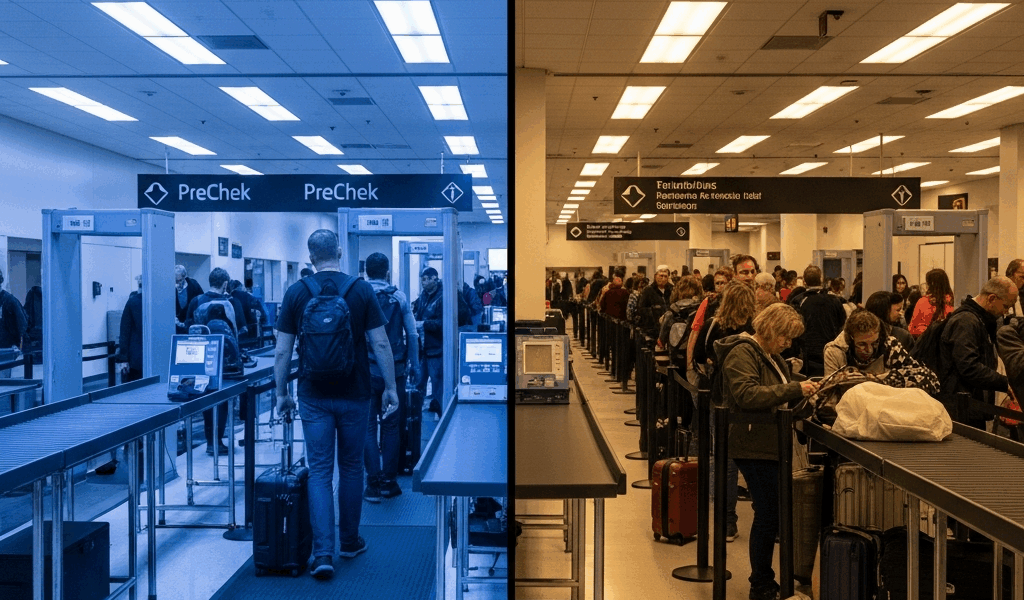
For most travelers, TSA PreCheck is the better first purchase. It changes the physical screening process at 200+ airports: eligible travelers can generally keep shoes, belts, and light jackets on and leave compliant liquids and laptops packed. CLEAR+ performs a different job at participating checkpoints: it verifies identity and moves members toward bag screening, but it does not replace TSA screening or automatically provide PreCheck benefits.
Frequent flyers whose regular terminals have functioning CLEAR+ lanes may benefit from having both. The decision depends on your airports, terminals, travel frequency, eligibility, privacy preferences, and whether a credit card or loyalty program offsets the cost.
Prices and locations checked August 1, 2026. Verify them on the official enrollment pages before paying because provider fees, promotions, lane locations, and operating hours change.
TSA PreCheck vs CLEAR+: quick comparison
| Feature | TSA PreCheck | CLEAR+ |
|---|---|---|
| What it changes | Physical security-screening lane and procedures | Identity/document-check portion before bag screening |
| Current standard price | Provider-dependent; for example, IDEMIA lists $76.75 for five years and CLEAR lists $79.95 | $219 per year before eligible discounts or credits |
| Term | Five years after approval | Annual, automatically renewing unless canceled |
| Coverage | 200+ airports and 90+ participating airlines | More than 150 lanes across 62 airports; terminal and hour restrictions apply |
| Enrollment | Application, in-person identity/fingerprint enrollment, security threat assessment, then Known Traveler Number if approved | Identity and biometric enrollment under CLEAR’s eligibility rules |
| Children | Children 17 and under may accompany an eligible adult when the PreCheck indicator appears on the child’s boarding pass | Children 17 and under may accompany a CLEAR+ member in the lane for free |
| Best for | Most eligible U.S. travelers who fly several times over five years | Frequent users of airports and terminals with useful CLEAR+ coverage |
What TSA PreCheck actually does
TSA PreCheck is a federal trusted-traveler screening program. Approved travelers receive a Known Traveler Number, or KTN, which must be added correctly to the airline reservation. When TSA PreCheck appears on the boarding pass, the traveler can use the designated lane where available.
The typical benefits are:
- shoes, belts, and light jackets can remain on;
- compliant 3-1-1 liquids and laptops can remain in the carry-on;
- screening occurs in a dedicated lane at participating checkpoints; and
- approved membership remains valid for five years unless TSA determines the traveler is no longer eligible.
PreCheck is not a promise of zero waiting or identical procedures every trip. TSA uses unpredictable security measures, participating lanes can close, and the indicator may not appear if the KTN, name, birth date, or reservation data do not match. Approval also does not exempt anyone from additional screening.
How much TSA PreCheck costs in 2026
TSA uses multiple enrollment providers, including IDEMIA, CLEAR, and Telos. Fees and enrollment locations differ. At the time of this review:
- IDEMIA lists new enrollment at $76.75 for five years, online renewal at $58.75, and in-person renewal at $66.75.
- CLEAR’s government-authorized PreCheck enrollment site lists new enrollment at $79.95 and online renewal at $69.95.
These are fees for the same TSA PreCheck program through different enrollment providers. Enrolling in TSA PreCheck through CLEAR does not by itself create a paid CLEAR+ airport membership. Compare the official providers listed by TSA for current price and convenient locations.
What CLEAR+ actually does
CLEAR+ is a private, paid identity-verification membership. At a supported airport checkpoint, the member enters a CLEAR+ lane, scans a boarding pass, and verifies identity using CLEAR’s system. Depending on the airport’s setup, a CLEAR ambassador or eGate routes the traveler toward bag screening.
CLEAR+ does not decide whether you receive PreCheck. If your boarding pass has the PreCheck indicator and that checkpoint supports the combination, CLEAR+ can move you through identity verification toward the PreCheck screening lane. Without PreCheck, you normally continue to standard physical screening.
CLEAR lists a standard membership price of $219 per year as of August 2026. It lists more than 150 CLEAR+ lanes at 62 airports, but airport-level totals can be misleading: a service may operate only in certain terminals, checkpoints, directions, or hours. Check the exact terminal you normally use, not merely the airport name.
CLEAR+ family access and discounts
CLEAR currently allows a primary member to add up to three adults for $125 per person annually. Children 17 and under may accompany a CLEAR+ member without a separate paid membership. CLEAR also publishes military, government, airline-status, and eligible credit-card pricing or credits. Those benefits and enrollment offers change, so confirm them with CLEAR and the card issuer before relying on them.
Which one saves more time?
There is no honest universal answer. Each program removes a different bottleneck:
- If the longest delay is the physical screening line and unpacking process, TSA PreCheck addresses the larger problem.
- If the identity-check queue is long but the screening lane is moving, CLEAR+ may help.
- If a checkpoint combines CLEAR+ with PreCheck efficiently, having both can remove friction from both stages.
- If the CLEAR+ lane is closed, understaffed, located in another terminal, or longer than the ordinary identity queue, it may save no time.
Do not rely on claimed average wait times as a guarantee. Passenger volume, staffing, equipment, checkpoint configuration, airline terminal, time of day, and irregular operations all change the result. Look at your own last several departures: where did you actually wait?
Who should choose TSA PreCheck?
Choose TSA PreCheck first if you:
- are eligible and take several domestic departures over five years;
- use a mix of large and small U.S. airports;
- want the easier screening procedure more than an identity-line shortcut;
- travel with children who can receive the indicator on their boarding passes; or
- want much broader airport and airline coverage at a lower annualized cost.
Before applying separately, check whether you already receive PreCheck eligibility through Global Entry, NEXUS, SENTRI, an active TWIC, or another qualifying credential. Follow the relevant agency’s instructions for placing the membership number in your airline profile.
Who should choose CLEAR+?
CLEAR+ is most defensible when all of these are true:
- you fly frequently enough for an annual membership to matter;
- your home and common destination terminals have CLEAR+ lanes during your usual hours;
- identity-document queues are a recurring bottleneck;
- you are comfortable with CLEAR’s identity-verification and biometric terms; and
- the net cost is reasonable after any confirmed credit or loyalty discount.
Check CLEAR’s location page for the checkpoint and hours immediately before deciding. An airport with CLEAR in Terminal A does not help if your airline consistently departs from Terminal C without an accessible CLEAR lane.
When having both makes sense
The programs are complementary. CLEAR+ handles identity verification; PreCheck changes screening. A frequent flyer who consistently uses participating combined checkpoints may get the smoothest path with both.
CLEAR currently advertises a first-year bundle through its authorized PreCheck enrollment channel. Promotions and rebate mechanics can change, and CLEAR+ renews annually while PreCheck lasts five years, so read the checkout and renewal terms carefully. Compare the bundle against enrolling through another PreCheck provider and obtaining CLEAR+ separately.
Privacy and security considerations
Both programs require identity information, but they are not the same relationship. TSA PreCheck is administered by TSA and includes a government security threat assessment with biometric enrollment. CLEAR+ is a private membership governed by CLEAR’s terms and privacy policy and uses identity-verification technology for its services.
Read the current disclosures before enrolling. Consider what information is collected, how biometric identifiers are used and retained, who receives them, how to cancel, and how to request account deletion. Convenience does not remove the need for informed consent.
Five-minute decision checklist
- List the airports, terminals, and departure times you used most in the past year.
- Check whether those airlines and checkpoints support PreCheck.
- Check CLEAR’s current location page for the exact terminals and operating hours.
- Identify your actual delay: identity line, physical screening, or both.
- Check existing trusted-traveler credentials, card credits, and loyalty discounts.
- Compare five-year PreCheck cost with CLEAR+’s annual renewal cost.
- Read the privacy and cancellation terms before submitting biometrics or payment.
Related airport-security guides
- How to get through TSA faster at any airport
- What slows TSA lines and how to move faster
- What to do when your PreCheck indicator disappears
- Do travelers over 75 still need TSA PreCheck?
Official sources
- Transportation Security Administration: TSA PreCheck
- TSA PreCheck enrollment through IDEMIA
- TSA PreCheck enrollment through CLEAR
- CLEAR+: current price, locations, and family terms
- CLEAR: difference between CLEAR+, PreCheck, and Global Entry
Bottom line: if you can buy only one, TSA PreCheck is the better default for most eligible travelers. Add CLEAR+ only after confirming that its lanes solve a repeated problem at the terminals and hours you actually use.



Stay in the loop
Get the latest airport guides world updates delivered to your inbox.