How to Confirm Your Upgrade Is Real
I got upgraded to first class on a Southwest flight once, and I genuinely thought the gate agent had made a mistake. She called my name, and all I heard was “upgraded,” but I spent the next ten minutes convinced she’d mixed me up with someone else. Upgrade confusion catches passengers off guard because, honestly, nobody expects it — and it happens more often than you’d think.
When a gate agent announces your upgrade at the gate, that’s your first official notification. Listen for your name and confirmation number. They’ll hand you a new boarding pass, and that’s the moment everything changes. Look at it immediately. Your new boarding pass will show a cabin class different from your original booking. Instead of “Economy” or “Coach,” you’ll see “First,” “Business,” “Premium Cabin,” or “Premium Plus” — depending on which airline you’re flying.
Your original boarding pass said seat 24C? Your new one says 2A. That’s your upgrade confirmation right there.
Some airlines send email confirmations within minutes. Check your email before boarding. Southwest doesn’t do this, but American, Delta, and United typically will. The email spells out exactly what changed — the cabin, seat number, any fee waivers, what amenities you now have access to.
Here’s what trips people up: if you booked through Kayak or Expedia, the airline’s system might not immediately sync your upgrade. You could have a legitimate first-class boarding pass in your hand, but the airline app still shows economy. This isn’t a scam — it’s a sync lag. The physical boarding pass is the source of truth. Take a photo of it.
Probably should have opened with this section, honestly — if you’re skeptical, ask the gate agent directly. Say, “I want to confirm this is a legitimate upgrade and not a mistake.” They’ll verify your record on their system. Gate agents deal with confused upgrade passengers constantly. They won’t judge you.
What Happens at the Gate and Boarding
Boarding with a first-class upgrade changes your entry timing in ways that confuse new upgrade passengers.
You’ll board earlier than your original group. If your original ticket showed “Group 5,” you now board in the first-class group — usually called “Priority Boarding” or “Group 1.” The gate agent will call your new group before economy boarding even starts. Walk up when they call premium cabin passengers. Don’t wait for your original group number.
At the gate, the agent scans your new boarding pass. Nothing special here — it’s identical to any other passenger. The system registers you as first class, and you proceed down the jetway like normal.
If your travel companion wasn’t upgraded, here’s the awkward part: do you board together or separately? You board together. Walk down the jetway with them. When you reach the cabin, you split off to your respective seats — you to 2A in first class, them to 24C in economy. It takes thirty seconds and feels weird the first time, but it’s completely normal. Flight attendants see this constantly.
Seat selection depends on airline policy. Some carriers let upgrade passengers choose their first-class seat at the gate. Others assign it automatically. Ask the gate agent: “Can I select my first-class seat, or is it assigned?” If you can choose and you’re traveling with someone in economy, pick a window seat. You’re not staring directly at your companion’s economy row through the cabin divider. It’s less awkward for everyone.
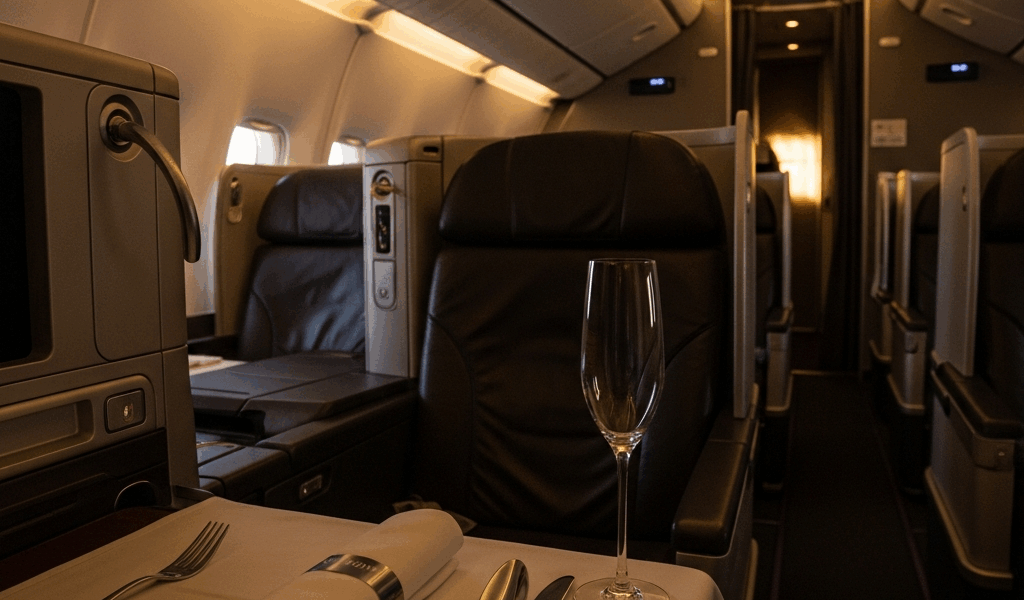
Finding your new seat is straightforward. First-class seat numbers are smaller — typically rows 1 through 4 on domestic flights. Walk forward from the jetway entrance. Your seat will be clearly marked. If you’ve never sat in an airline first-class seat before, it’s wider than you expect. The armrests often fold up. Don’t break anything trying to figure out how it works — flight attendants will explain seat mechanics during the safety demo.
Understanding Premium Cabin Amenities and Food Service
First-class amenities are generous, but the timing and logistics confuse passengers who’ve never experienced them.
You’ll get a pre-flight beverage service before takeoff. A flight attendant will approach with a cart carrying orange juice, water, coffee, tea, and — on most carriers — champagne or a cocktail option. This happens as soon as the cabin door closes. You don’t ask for it; they offer it to every first-class passenger. Say yes or no. That’s it.
Meal timing depends on flight length. On flights under three hours, expect a light meal — a snack box, sandwich, or salad — served about thirty minutes after takeoff. Longer flights get full meal service with appetizers, entrées, and dessert, typically starting forty minutes into the flight. Domestic flights under five hours get simplified service. International flights? Full meals with multiple courses.
The beverage cart comes around multiple times. After the initial service, flight attendants circulate with drinks throughout the flight. This isn’t economy’s single beverage cart pass. You can ask for refills. You can ask for beer, wine, or spirits on most airlines — alcohol service is complimentary in first class on full-service carriers.
Your seat comes with a pillow and blanket provided automatically. The blanket quality is significantly better than economy. It’s thick, quilted — not a thin polyester rectangle. The pillow is full-sized. Both are yours for the entire flight.
Amenity kits appear on long flights — usually international routes over five hours. You’ll get a zippered pouch with socks, an eye mask, lip balm, a toothbrush, and toothpaste. On some airlines, the kit is more luxurious with moisturizer and earplugs included. Take the whole kit. Many passengers don’t realize they can keep it.
Entertainment systems in first class are identical to economy on most domestic carriers. Your seatback screen offers movies, TV shows, and music. Some premium cabins have larger screens or higher resolution, but the content is the same. Noise-canceling headphones are sometimes provided — ask a flight attendant if you’re unsure.
Seat controls feel unfamiliar at first. Your seat probably reclines fully or partially — you’ll have a control panel with buttons for recline, lumbar support, and footrest adjustment. Press the recline button gently. The seat moves slowly and deliberately. Fumbling with controls for two minutes before getting frustrated? That’s completely normal. Flight attendants expect it.
Common Mistakes Upgrade Passengers Make
I’ve watched hundreds of first-time upgrade passengers make preventable errors.
Declining the meal because you’re not hungry yet, thinking you’ll request it later — this is the biggest mistake. First-class meal service is timed to the flight schedule, not your appetite. If the attendant offers you a meal and you say no, they won’t come back with it mid-flight. You’ll be stuck with snacks and beverages for the rest of the flight. Even if you’re not starving, take the meal. You can eat it later or eat half and save the rest.
Not reclining the seat because you’re worried about bothering the person behind you — there’s nobody directly behind you in first class. Recline it. That’s why you’re in first class.
Missing the beverage cart because you’re unfamiliar with timing — premium cabin service happens fast. The cart hits first-class passengers first, then economy. This occurs before you’ve had time to settle in. Be ready. Don’t disappear to the bathroom right after takeoff.
Leaving belongings behind is surprisingly common. You’re used to economy, where you’ve been vigilant about your stuff the whole flight. First class is spacious. You set your phone on the armrest, your boarding pass on the tray table, your jacket in the overhead bin. Then you deplane and leave everything behind. Before you deplane, do a physical sweep of your seat area. Check the armrest pockets, the tray table, and the overhead bin directly above your seat.
Assuming everything in first class is complimentary — it mostly is, but not always. Alcoholic beverages are free on full-service carriers. Premium snacks and meals are free. But on some airlines, you’ll get a printed menu with items marked as “Complimentary” and items with prices. Premium wine selections, specialty spirits, and premium snacks sometimes cost extra. Before ordering something not explicitly offered by a flight attendant, ask: “Is this complimentary?” It takes three seconds and avoids awkwardness at the end of the flight.
What to Do If You’re Uncomfortable With the Upgrade
Not everyone wants a first-class upgrade. This sounds absurd, but it happens regularly.
You might have mobility concerns. First-class seats recline fully, which is uncomfortable for some people — particularly those with back or joint issues. The aisle is narrower than you expected. Getting to and from your seat feels awkward. You’d genuinely prefer the room and accessibility of economy.
You might be anxious. First class feels formal and intimidating. You don’t know the unspoken rules. You’re worried you’ll do something wrong and embarrass yourself. You’d rather sit in the familiar economy cabin.
You might have social anxiety about sitting near or interacting with other premium passengers. That’s legitimate.
Here’s what you can do: politely ask the gate agent to move you back to economy. Tell them you’re uncomfortable with the upgrade. Be honest. Don’t over-explain. Say, “I appreciate the upgrade, but I’d prefer to stay in economy for this flight.” Gate agents will accommodate this request if the flight isn’t completely full. They’ll rebook you into your original economy seat or a similar one.
Timing matters. Ask immediately when the upgrade is offered — at the gate, before boarding. Don’t board and then change your mind mid-flight. Moving from the cabin mid-flight is technically possible but creates logistical problems for the flight crew.
If you’re booked with someone in economy and they strongly prefer you stay with them, you can decline the upgrade. Some airlines allow this; others consider the upgrade non-refundable and won’t move you back without a legitimate reason. Ask the gate agent explicitly: “Can I decline this upgrade and keep my economy seat?”
Most upgrade passengers stay. The meals are excellent. The space is real. The experience is genuinely valuable. But the option to decline exists, and flight crews understand that not everyone wants premium cabin service.


Stay in the loop
Get the latest airport guides world updates delivered to your inbox.