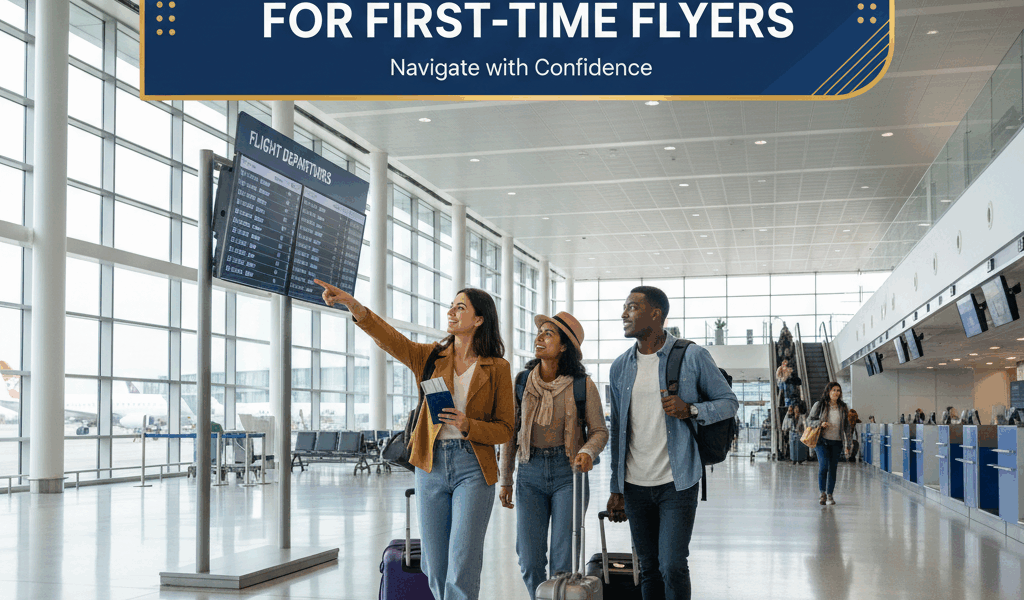
Your Complete Guide to First-Time Air Travel
Flying for the first time can feel overwhelming. This guide walks through every step from booking to baggage claim so you know exactly what to expect.
Before You Leave Home
Documentation
- Domestic flights: Government-issued photo ID (driver’s license, state ID, or passport)
- International flights: Valid passport (check expiration—many countries require 6+ months validity)
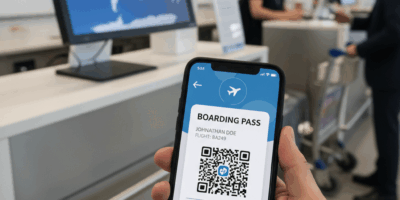
- Boarding pass: Print at home, use airline app, or get at airport kiosk
Packing
Carry-on bag: Typically 22″ x 14″ x 9″ maximum. Contains items you need during flight and anything valuable.
Personal item: Backpack, purse, or laptop bag that fits under the seat.
Checked bag: Larger suitcase that goes in cargo hold. Weight limits typically 50 lbs for economy.
TSA liquid rules: Carry-on liquids must be 3.4 oz (100ml) or less, all fitting in one quart-sized clear plastic bag.
Arriving at the Airport
When to Arrive
- Domestic flights: 2 hours before departure
- International flights: 3 hours before departure
- Peak travel times: Add 30 minutes (holidays, Monday mornings, Friday afternoons)
Finding Your Airline
Large airports have multiple terminals. Check your airline’s terminal before arriving. Signs direct you from parking or drop-off areas to the correct terminal.
Check-In Process
Options
- Online check-in: Available 24 hours before departure via airline website or app
- Airport kiosk: Touch-screen machines in terminal lobby
- Counter agent: For complex itineraries, checked bags, or assistance
Checking Bags
If checking luggage, proceed to the airline counter or bag drop after getting your boarding pass. An agent will tag your bag and give you a claim ticket. Keep this ticket—you’ll need it if bags are delayed.
Security Screening
The TSA Process
- ID check: Show boarding pass and photo ID to TSA officer
- Prepare belongings: Remove laptop, liquids bag, shoes, belt, and jacket
- X-ray screening: Place items in bins on the conveyor belt
- Body scanner: Stand in the machine with arms raised for 3 seconds
- Collect belongings: Retrieve items from the end of the conveyor
Prohibited Items
- Weapons of any kind
- Sharp objects (scissors over 4″, knives)
- Liquids over 3.4 oz
- Lighters in checked bags (allowed in carry-on)
When in doubt, check TSA.gov or pack it in checked luggage.
Finding Your Gate
After security, you’re in the secure terminal area. Your boarding pass shows your gate number (example: B24 means Concourse B, Gate 24).
Follow signs to your concourse. Gates are numbered sequentially—if you’re at B10 and need B24, walk in the direction of increasing numbers.
Important: Gates can change. Check departure screens or your airline app for updates.
Boarding the Plane
Boarding Groups
Airlines board in groups (numbered or named). Your boarding pass shows your group. Listen for announcements or watch the gate screen.
Typical order:
- Pre-boarding (wheelchair assistance, families with young children)
- First class and business class
- Elite frequent flyers
- Main cabin groups (usually back to front or by fare class)
On the Plane
- Find your row number on overhead bins
- Store carry-on in overhead bin, personal item under seat
- Locate your seat (A and F are windows, middle letters are middle seats)
- Buckle seatbelt, stow tray table, open window shade for takeoff
During the Flight
- Seatbelt sign: Stay seated when illuminated
- Flight attendant call button: Overhead panel for assistance
- Restrooms: Located at front and rear of cabin
- Entertainment: Seatback screens or streaming to your device (download airline app before flight)
- Ears popping: Chew gum, yawn, or swallow during takeoff and landing
Arriving at Your Destination
Deplaning
Wait for the seatbelt sign to turn off. Rows exit front to back—wait your turn. Collect all belongings from overhead bin and under seat.
Baggage Claim
If you checked bags, follow signs to baggage claim. Screens show which carousel serves your flight. Wait for bags to appear on the conveyor (usually 15-30 minutes after landing).
Ground Transportation
Follow signs for your transportation method:
- Rental cars: Shuttle buses to rental car center
- Rideshare/taxi: Designated pickup areas outside baggage claim
- Hotel shuttles: Usually at designated curb areas
- Public transit: Follow train/bus signs
Common First-Time Concerns
Turbulence: Normal and safe. Planes are designed to handle it. Keep seatbelt fastened when seated.
Ear pressure: Swallowing, yawning, or the Valsalva maneuver (pinch nose, close mouth, gently exhale) helps equalize.
Motion sickness: Request a window seat over the wing. Focus on the horizon. Ginger or motion sickness medication helps some travelers.
Fear of flying: Statistically the safest transportation mode. Focus on the destination, not the journey. Many find window seats reassuring.



Stay in the loop
Get the latest wildlife research and conservation news delivered to your inbox.