Today, I will share it all with you.
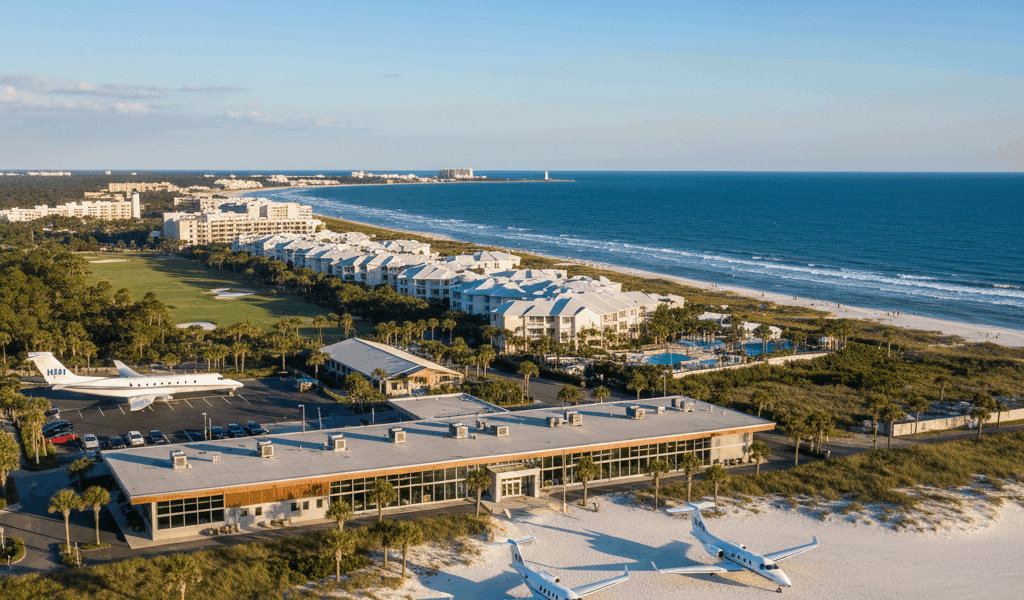
Hilton Head Airport (HHH) isn’t going to blow you away with its size or international route map. What it does have is charm, a gorgeous coastal setting, and surprisingly good opportunities for photography that you won’t find at your typical regional hub. I’ve shot there on several visits over the years, and it keeps drawing me back.
The Terminal Itself

The design reflects the island’s character perfectly — coastal, relaxed, welcoming. It’s a single terminal, simple and functional, but they’ve infused it with enough local touches that you genuinely feel like your vacation has already started the moment you walk in. I remember stepping out of the jet bridge for the first time and thinking, “This doesn’t feel like an airport.”
Natural light pours through the space in ways that make my photographer brain light up. The interior has this airy, open quality that photographs beautifully, especially in the early morning when the light angles in at just the right slant. Clean lines, open spaces, and a real sense of place that so many regional airports completely lack.
Check-In and Security
Small airport means smaller crowds and shorter lines — music to any traveler’s ears. Delta and American operate here, along with some seasonal carriers. The streamlined nature of the whole operation makes it feel almost civilized, like air travel used to be before everything got so stressful.
For photography, the security area tells its own story — that efficient progression from entrance to gate, the calm flow of people who aren’t stressed out of their minds. Not the most dramatic subject, but it says something about how regional airports can work when they’re not bursting at the seams.
Amenities

You’re not going to find shopping malls or sprawling food courts here. Basic WiFi, some vending machines, comfortable seating with views of the runways — that’s the package. What you do get are those large windows that let you watch planes come and go against the lowcountry sky, and honestly, that’s better than any duty-free shop.
The waiting areas make wonderful subjects for candid work. Travelers at rest, that quiet anticipation before departure, reunion moments at arrivals where families spot each other and their faces transform. The relaxed atmosphere creates more natural human moments than the stressed chaos of bigger airports, and those moments are gold if you know how to capture them.
Plane Spotting
For aviation enthusiasts, this is where things get genuinely interesting. Regional jets and private planes against the coastal South Carolina sky create compositions you simply can’t get at major hubs. The airport accommodates both commercial and private traffic, so there’s real variety in what rolls past your lens.
The runways have that quintessential lowcountry backdrop — flat land stretching out, enormous sky overhead, hints of marsh landscape in the distance. Planes taking off or landing frame naturally against this environment. Sunset shots, if you time it right, can be genuinely stunning. I caught a regional jet silhouetted against a pink and orange sky one evening that’s still one of my favorite aviation photos.
Ground Transportation Views
The parking lot and rental car area are compact — typical regional airport stuff. But there’s something worth documenting in that connection between the airport and the island. You’re photographing not just transit infrastructure, but the actual gateway to Hilton Head itself. The transition from travel mode to vacation mode happens right there in the parking lot, and faces tell that story beautifully.
Environmental Sensitivity
The airport sits in a delicate coastal ecosystem, and they’ve built and maintained it with genuine environmental considerations. That integration of infrastructure and nature shows in the surrounding areas — the careful balance between serving travelers and preserving what makes the island special in the first place. It’s worth documenting, because not every airport manages that balance this thoughtfully.
Events and Community
Throughout the year, aviation events bring enthusiasts and locals together at HHH. Aircraft displays, educational programs, community gatherings. These events offer concentrated photography opportunities — people engaging with aviation, planes on static display, the intersection of hobby and community that only happens at smaller airports.
If you can time a visit to coincide with one of these events, you’ll get more varied subjects than a typical travel day provides. I try to check the schedule whenever I’m planning a trip to the area.
Tips for Shooting Here
Early morning light works best for the terminal interior — those angled rays create beautiful patterns. Late afternoon is your window for runway shots when the light goes warm and golden. Overcast days actually help by reducing harsh shadows for more even exposure across your frame. The humid coastal air can create interesting atmospheric effects too, especially during warmer months when everything gets a bit hazy.
Bring a longer lens for runway shots if plane spotting is your goal — you’ll want the reach. Wide angles work wonderfully inside the terminal for capturing the architecture and light. And don’t overlook the candid human moments — this relaxed airport creates a completely different energy than the stressed crush of major hubs, and that energy translates into more genuine photographs.
Hilton Head Airport won’t give you the dramatic architecture of JFK or the sweeping scale of DFW. What it offers is intimate coastal charm and the visual connection between travel infrastructure and the natural beauty of the lowcountry. Sometimes the quieter subject tells the better story.
Recommended Aviation Gear
David Clark H10-13.4 Aviation Headset – $376.95
The industry standard for aviation headsets.
Pilots Handbook of Aeronautical Knowledge – $25.42
Essential FAA handbook for every pilot.
As an Amazon Associate, we earn from qualifying purchases.

Stay in the loop
Get the latest airport guides world updates delivered to your inbox.