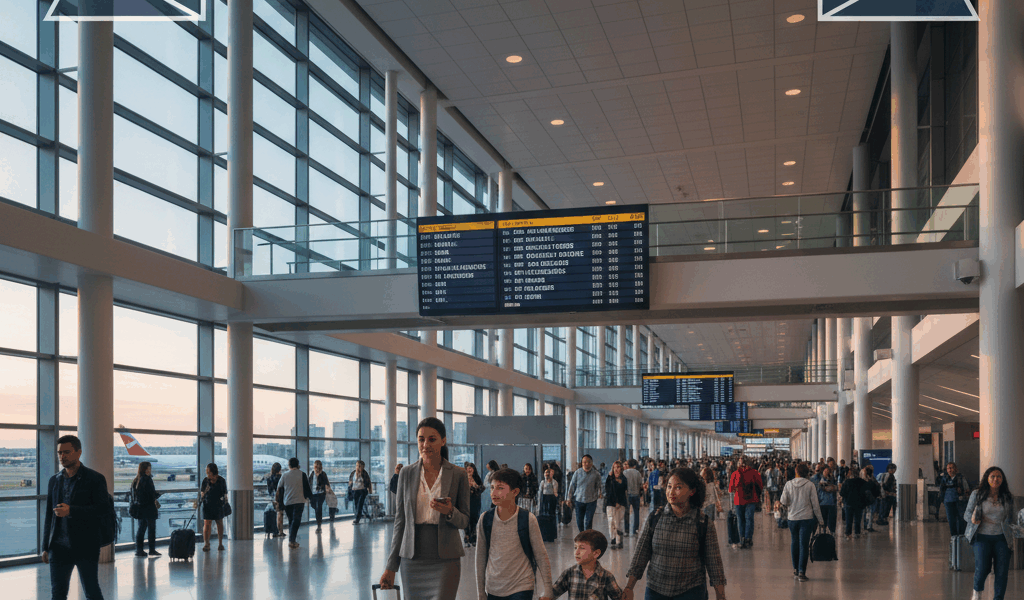
Understanding America’s Busiest Airport Hubs
The United States operates over 5,000 public airports, but a handful handle the majority of passenger traffic. Knowing how these major hubs work helps you navigate them efficiently.
Hartsfield-Jackson Atlanta (ATL)
The world’s busiest airport by passenger traffic serves as Delta’s primary hub. Key facts:
- Passengers: 93+ million annually
- Layout: Domestic terminal with 7 concourses connected by underground train
- Walking times: Concourse T to F takes 25+ minutes without the train
- Best feature: The Plane Train moves 200,000 passengers daily between concourses
Tip: International arrivals clear customs in Concourse F, then must take the train to reach domestic connections.
Dallas-Fort Worth (DFW)
American Airlines’ largest hub sprawls across 17,000 acres—larger than Manhattan island. Layout:
- 5 terminals: A, B, C, D, and E arranged in a semicircle
- Skylink: Free automated train connects all terminals (full loop takes 20 minutes)
- Terminal specialty: International flights primarily use Terminal D
Tip: Terminals A, B, and C are connected airside. D and E require Skylink or re-screening if walking outside.
Denver International (DEN)
Opened in 1995, Denver features distinctive white tent-like roof peaks visible for miles. Structure:
- Main terminal: Jeppesen Terminal handles ticketing and security
- 3 concourses: A, B, and C accessed by underground train
- Concourse B: Largest, serving United’s hub operations
- Unique feature: Controversial murals and artwork spark conspiracy theories
Tip: Allow 45+ minutes for connections between Concourse A and C. The train runs every 2-3 minutes.
Chicago O’Hare (ORD)
United and American both hub here, creating one of the most complex airport environments:
- 4 terminals: 1, 2, 3, and 5 (no Terminal 4)
- Terminal 1: United hub
- Terminal 3: American hub
- Terminal 5: International arrivals
- ATS train: Connects all terminals, but T5 requires exiting security
Tip: Terminal 5 connections require re-clearing security. Allow 90+ minutes for international-to-domestic connections.
Los Angeles (LAX)
Nine terminals arranged in a U-shape around the central theme building create navigation challenges:
- Terminals 1-8: Domestic operations (each airline has preferred terminals)
- Tom Bradley International Terminal (TBIT): Most international flights
- No airside connections: Moving between most terminals requires exiting and re-screening
Tip: An underground connector links TBIT to Terminals 4-8 airside. Check if your connection qualifies.
John F. Kennedy (JFK)
New York’s primary international gateway operates 6 terminals with limited connections:
- Terminal 1: International carriers
- Terminal 4: Delta hub, major international terminal
- Terminal 5: JetBlue (historic TWA terminal)
- Terminal 7: British Airways, other airlines
- Terminal 8: American Airlines
- AirTrain: Connects all terminals but requires exiting security
Tip: Most terminal-to-terminal connections at JFK require AirTrain and security re-screening. Allow 2+ hours.
San Francisco (SFO)
United’s Pacific gateway features a more connected layout:
- 4 terminals: 1, 2, 3, and International
- AirTrain: Connects all terminals and BART station
- Advantage: Most terminals connected airside post-security
Tip: SFO has notoriously fog-prone runways. Check flight status before heading to the airport.
Seattle-Tacoma (SEA)
Alaska Airlines and Delta’s West Coast hub in a single terminal:
- Central terminal: Main ticketing and security
- 4 concourses: A, B, C, D plus satellite (S gates)
- Satellite: Requires underground train to reach S gates
Tip: S gates are far from the main terminal. If connecting to an S gate, head there immediately after clearing security.
General Tips for Major Hubs
- Minimum connection times: Airlines set these, but add buffer for first-time visits
- Mobile apps: Download airport and airline apps for real-time gate information
- Lounge access: Major hubs have multiple lounge options for delays
- Ground transportation: Research options before landing—major hubs have trains, buses, rideshare, and taxis



Stay in the loop
Get the latest wildlife research and conservation news delivered to your inbox.