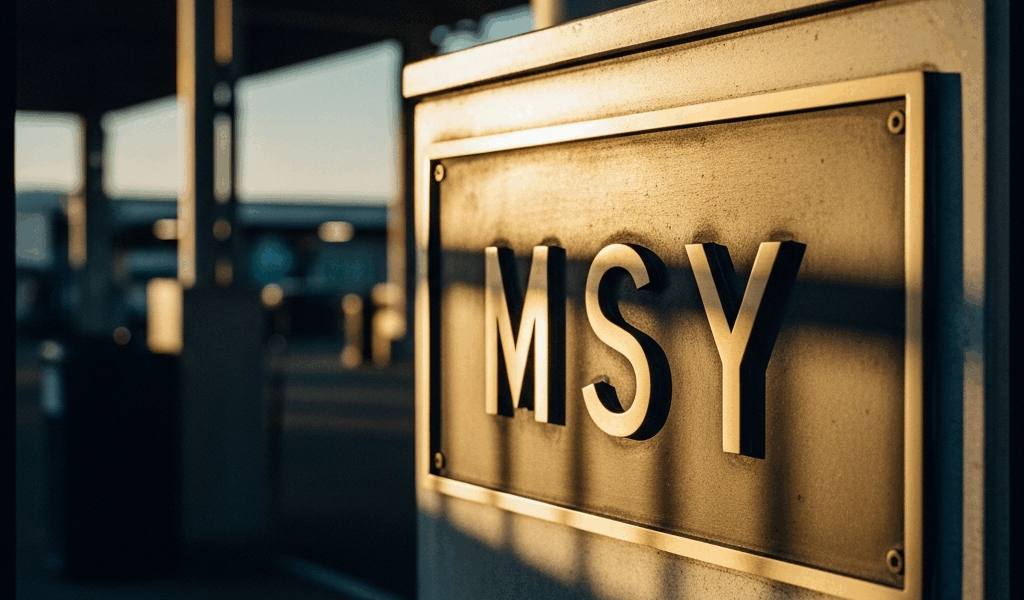
Why Is MSY the Airport Code for New Orleans?
Airport codes have gotten complicated with all the assumptions flying around. Everyone thinks they follow city names. Sometimes they do. Often they don’t. And MSY — the three-letter code for New Orleans Louis Armstrong International — is probably the most interesting example of why that assumption falls apart completely.
As someone who has spent years cataloguing airport code origins, I learned everything there is to know about MSY specifically. Today, I will share it all with you.
The short version: a barnstorming daredevil, a cattle yard, and a piece of Louisiana land that most people flying through never think about once. The long version is considerably better.
John Moisant — The Daredevil Pilot
Probably should have opened with this section, honestly — though the stock yard twist earns its place later.
But who was John Moisant? In essence, he was one of the most reckless celebrated aviators of the early 20th century. But he was much more than that.
Born in Illinois in 1868, Moisant came up during an era when aviation wasn’t really a career. It was closer to a dare. Planes ran on spruce, linen, and what I can only describe as aggressive optimism — and the pilots who flew them treated mortality like a mildly interesting advisory notice.
His defining moment came in 1910. Frustrated by the limitations of solo exhibition flights, Moisant attempted something genuinely unprecedented — crossing the English Channel with an actual passenger aboard his Blériot monoplane. Not just himself. Another human being. That man was his mechanic, Albert Fileux, who was either extraordinarily brave or not fully briefed on the situation. The crossing ran about 37 minutes. The plane weighed roughly 500 pounds fully loaded. No meaningful instruments. Open water below. They made it across from Calais to Dover without incident.
This new reputation took off in the months that followed and eventually evolved into a full exhibition circuit that aviation enthusiasts knew and followed obsessively. Moisant flew a Blériot XI — same model that conquered the Channel — racing other pilots for prize money and spectacle across venues that drew tens of thousands of spectators at a time.
On December 31, 1910, competing in the Michelin Cup race near New Orleans, his plane went down. He was thrown from the cockpit. He died from his injuries that same day. He was 42. The crash site was a stretch of flat, open Louisiana land southwest of the city — the kind of coastal plain geography that looks like nothing until you realize it’s essentially a natural airstrip.
Motivated by grief and the obvious utility of that terrain, local aviation advocates pushed to memorialize Moisant at the exact site where he died. An airfield went up there in 1923. They called it Moisant Field. That’s what makes Moisant endearing to us aviation history obsessives — his name stuck to that land in a way that would echo forward for a century.
Stock Yards to Runway
So, without further ado, let’s dive into the part that makes airport geography nerds genuinely happy.
Before Moisant Field existed — before the crash, before the airstrip, before any of it — that land already had a name. The Moisant Stock Yards operated on that exact property. A working livestock facility handling cattle in the agricultural flow of early 20th century Louisiana. The kind of operation that never makes headlines but shapes the physical identity of a place in ways that outlast it by generations.
When the International Air Transport Association began standardizing airport codes — a process that formalized largely through the 1940s and 1950s — the codes didn’t always follow city names. They followed whatever the location was already called. ORD for Chicago O’Hare exists because O’Hare was previously Orchard Field. LAX has the X appended because two-letter codes were already in use and a third character was needed to expand the system. These aren’t city abbreviations. They’re fossils.
MSY follows exactly the same logic. The airport sat on Moisant Stock Yards land. The code reflected that specific history — not the city, not a geographic shorthand, not anything jazz-adjacent. The stock yards. A cattle operation that predated aviation at the site by decades ended up permanently embedded in the identifier that tens of millions of people now type into Google Flights every year without a second thought.
I’m apparently someone who finds this sort of thing fascinating, and honestly the MSY origin works for me while most other code stories never quite land the same way. Don’t make my mistake of assuming the obvious interpretation — early in my research I told a friend confidently that MSY probably stood for “Mississippi Y-something.” Wrong. Completely, embarrassingly wrong. The boring answer is almost never the right one with airport codes.
The Airport Today vs. Its Origins
Louis Armstrong New Orleans International Airport — the full official name since 2001 — opened a brand new terminal in November 2019. Terminal B. The project ran approximately $1.05 billion and replaced the aging facility that had been running since 1959. It’s 930,000 square feet, 35 gates, rooftop observation deck, local food vendors, architectural details that actually nod to New Orleans history. The kind of terminal that doesn’t feel like every other terminal — at least if you’ve suffered through enough generic airport interiors to appreciate the difference.
The airport sits about 13 miles west of the French Quarter in Jefferson Parish, serving roughly 13 million passengers annually in normal operating years. That geography still makes sense when you think about it — Moisant needed flat, open land in 1910, and that part of the metro had it in abundance.
The Louis Armstrong rename came in 2001. Armstrong was born in New Orleans in 1901 and spent his life carrying the city’s sound everywhere. The name fits. Nobody really argued.
But the code stays. MSY. That’s what makes the IATA system endearing to us history obsessives — codes that work don’t get changed just because their origin story went obscure. And in this case, that bureaucratic stubbornness accidentally preserved something worth keeping: three letters that contain a daredevil pilot, a cattle yard, and a New Year’s Eve crash from 1910, all compressed into the thing you type when you’re booking a flight to hear live jazz on Frenchmen Street.
Every time someone squints at their boarding pass and wonders what MSY actually means — there’s an entire story behind it. A man who flew across the English Channel in a linen airplane. A livestock facility that shaped a landscape. A coding system that preserved both without meaning to.
That’s the kind of history worth digging for. I haven’t found an airport code that beats it yet.

Stay in the loop
Get the latest airport guides world updates delivered to your inbox.