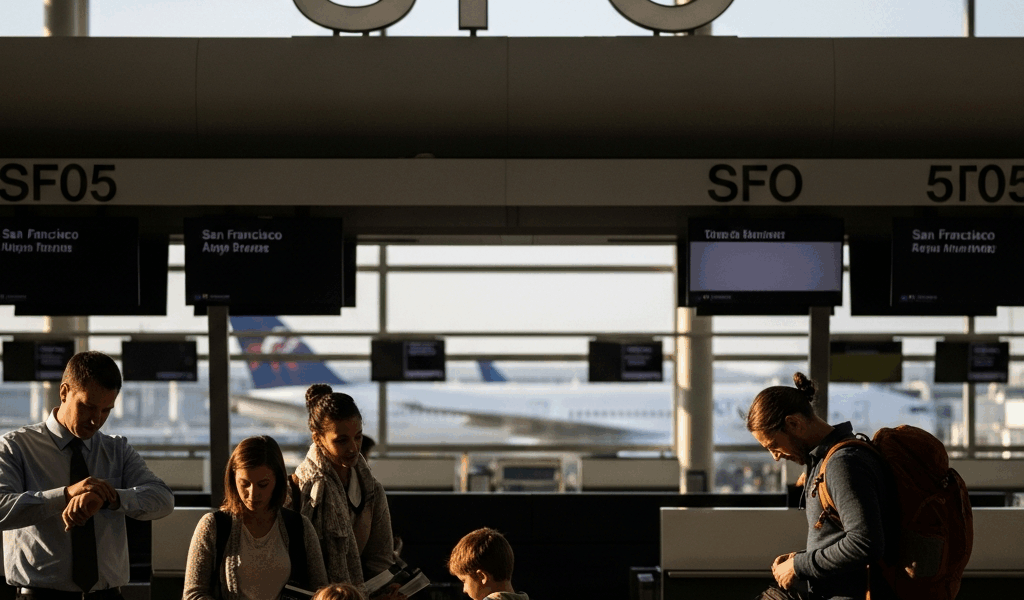
Why Is SFO the Airport Code for San Francisco?
If you’ve ever typed “why is SFO airport code San Francisco” into a search bar, you’re in good company. I’ve spent an embarrassing number of hours down the rabbit hole of airport code history — the kind of thing that starts as a quick curiosity on a layover and ends with you three tabs deep into FAA historical archives at midnight. The short answer is that SFO stands for San Francisco Official. But that explanation alone doesn’t do justice to the actual story, which involves a muddy airfield called Mills Field, a naming system that didn’t age perfectly, and a city that grew into one of the busiest aviation hubs on the planet.
What SFO Actually Stands For
SFO stands for San Francisco Official. That’s it. Not San Francisco Operations. Not San Francisco Open. Not some acronym invented by a clever marketing team in the 1970s. The “O” is simply “Official” — a designator used in the early days of aviation radio communication to distinguish an airport’s primary operational frequency or location from secondary ones.
Worth saying clearly — a lot of people assume the three-letter codes are abbreviations of the city name, and sometimes they are. SFO happens to be a near-perfect abbreviation. But the actual origin is more specific than that. When the IATA (International Air Transport Association) formalized the three-letter location identifier system in the mid-20th century, airports that had already been using identifiers under earlier systems got to keep them, more or less. San Francisco had been using SF-based identifiers since the 1930s. The “O” for Official stuck around and became canon.
Probably should have opened with this section, honestly — because once you know what the letters stand for, the rest of the history makes a lot more sense.
The Two-Letter Problem
Before IATA standardized three-letter codes globally, the United States used a two-letter system run by the Civil Aeronautics Authority (CAA). San Francisco was simply “SF.” Clean. Obvious. Then the problem arrived: as commercial aviation exploded post-World War II, two letters weren’t enough to uniquely identify every airport in the world. The switch to three-letter codes was a practical necessity, not a branding exercise. For cities that already had well-established two-letter identifiers, adding a third letter was the path of least resistance. “SF” became “SFO.”
The History Behind the Code
San Francisco International Airport wasn’t always international. It wasn’t even always called San Francisco International Airport. It started as Mills Field Municipal Airport of San Francisco, which opened in 1927 on a stretch of marshy bayland in San Mateo County — not technically in San Francisco at all. The field was named after Ogden Mills, whose family owned the land. The city of San Francisco leased it for $1 a year. Yes, one dollar annually. They had bigger concerns at the time.
Fascinated by how unglamorous the beginnings of major airports usually are, I dug through some old aviation almanacs and found that the original runway surface at Mills Field was basically graded dirt with drainage issues. Early pilots landing there in the late 1920s were dealing with a strip that flooded seasonally. The first scheduled airline service began in 1927 with a single-engine Fokker aircraft operated by Pacific Air Transport — and if you know anything about 1920s aviation, “scheduled” is doing a lot of work in that sentence.
The airport was renamed San Francisco Airport in 1931, then expanded significantly through the 1930s and 1940s. The name didn’t become “San Francisco International Airport” until 1954, reflecting the transatlantic and transpacific routes that were finally becoming commercially viable. The IATA code SFO was formalized around this same era, cementing what had already been in informal use by air traffic control and airlines for over a decade.
How the Code Traveled Through Aviation History
Intrigued by the apparent simplicity of SFO’s history, I expected to find some controversy — a competing airport that tried to claim the code, or a period where the FAA considered reassigning it. There really isn’t one. SFO got its code early and held it. The airport’s growth was aggressive enough that no one was going to bump it.
By 1958, SFO had a new passenger terminal and was handling jet aircraft. By 1974, it was processing over 20 million passengers a year. The code SFO traveled with the airport through every renovation, expansion, and naming update — through the addition of the International Terminal in 2000 (which cost approximately $1 billion to build), through the post-9/11 security overhauls, through the addition of the AirTrain automated people mover system. The three letters stayed constant while almost everything else about the airport changed.
One thing I got wrong for years — I assumed IATA and ICAO codes were the same thing. They’re not. The ICAO code for San Francisco International is KSFO, with the “K” prefix designating airports in the contiguous United States. KSFO is what pilots use in flight plans. SFO is what’s on your boarding pass. Two different systems, both valid, overlapping but distinct. I’ve made the mistake of conflating them in conversation more than once, and aviation people will absolutely correct you on it.
Other California Airport Codes and Their Stories
California is a good place to study airport codes because the state has so many major airports, and their codes follow such different logic. Once you start looking at SFO’s neighbors, you realize how inconsistent the system really is.
LAX — Los Angeles International
LAX is probably the most famous airport code in the world, and its origin is genuinely strange. Los Angeles was originally “LA” under the two-letter CAA system. When the switch to three letters happened, “X” was used as a placeholder — essentially a suffix with no meaning, added purely to fulfill the three-letter requirement. The “X” stands for nothing. It’s a bureaucratic artifact. The airport could have become LAA or LAB, but LAX was what got assigned, and now it’s iconic. A meaningless letter that became a cultural shorthand for everything Hollywood and West Coast.
SAN — San Diego International
SAN is one of the cleaner codes in the system. San Diego — SAN. No mystery there. The airport is officially named San Diego International Airport, and the code is a direct abbreviation of the city name. It was originally Lindbergh Field, named after Charles Lindbergh, who departed from a San Diego airstrip in 1927 before completing his transatlantic flight in the Spirit of St. Louis (which was actually built in San Diego, a fact the city never lets you forget). The code SAN has stuck even through the airport’s various name changes and terminal expansions.
SMF — Sacramento International
SMF is where things get a bit more obscure. Sacramento — why not SAC? The answer involves the fact that SAC was already in use by other identifiers when Sacramento’s airport code was being assigned, and the FAA doesn’t reassign codes casually. Sacramento Executive Airport, the city’s original general aviation field, had already claimed nearby letter combinations. The solution was SMF, which stands for Sacramento Metropolitan Field — a name the airport carried officially for several years before becoming Sacramento International. The Metropolitan in the name reflected its role serving the broader metro region rather than just the city proper. The airport’s Terminal B opened in 1998 and cost around $210 million. SMF stuck around long after “Metropolitan Field” faded from official usage.
OAK — Oakland International
OAK is the easiest code to decode in the Bay Area — it’s just the first three letters of Oakland. Simple. But OAK has an interesting relationship with SFO because the two airports exist in direct competition with each other, separated by about 20 miles. Airlines have used OAK as a cheaper, less-congested alternative to SFO for decades. Budget carriers love it. Travelers who don’t mind the BART ride to downtown San Francisco love it. The code OAK, versus the code SFO, represents a whole economic geography — one of those rare cases where two three-letter strings carry real financial weight for both airlines and passengers.
Airport codes are strange things. They’re administrative tools that turned into shorthand for entire travel experiences. SFO means the fog rolling in over the bay at 11pm, a delayed flight, the Golden Gate visible from the window on a clear approach. Three letters carrying all of that. And it started because someone at the Civil Aeronautics Authority looked at the letters SF and added an O for Official. That’s the whole story — mundane bureaucracy that accidentally became geography.

Stay in the loop
Get the latest airport guides world updates delivered to your inbox.