Do This Before You Leave the Airport
Lost luggage has gotten complicated with all the conflicting advice flying around. Go to the app. Call the hotline. Email customer service. Ignore all of that. Your bag didn’t show up on the carousel — the belt is slowing down, everyone else is grabbing their stuff, and your suitcase is just not there. Here’s what actually matters in the next twenty minutes.
Walk directly to the airline’s baggage service office. It’s always near baggage claim — usually marked with a sign, never more than a two-minute walk. File a Property Irregularity Report, or PIR, in person. Not by phone later. Not by email tomorrow. Right now, while you’re still in the building.
Probably should have opened with this section, honestly. I watched a travel companion wait until the next morning to file her report after our bags went missing on a connection through O’Hare, and the airline — Delta, in that case — used the delay as justification to drag the entire process out for weeks. Don’t make my mistake.
This single action starts the official clock. Most airlines won’t process any compensation, won’t intensify their search, won’t legally acknowledge the problem without a filed PIR sitting in their system. It’s also required by the Department of Transportation for domestic U.S. flights and by EC 261 regulations anywhere in Europe. That’s not a technicality. That’s the foundation everything else is built on.
Walk up to the desk. Take a breath. The agent behind that counter has handled this exact situation hundreds of times today alone. Stay factual. Skip the panic spiral about your ruined vacation.
Say this: “My checked bag didn’t arrive on [flight number]. My baggage claim ticket is [show it]. I need to file a Property Irregularity Report.”
They’ll ask for your boarding pass, your claim ticket, and your contact information. Then they’ll ask about the bag itself — color, size, brand, what’s inside. Be honest about contents. A $1,200 mirrorless camera, an $800 laptop, a $300 pair of boots — list them. There’s no penalty for having valuable items. Omitting them is the actual mistake.
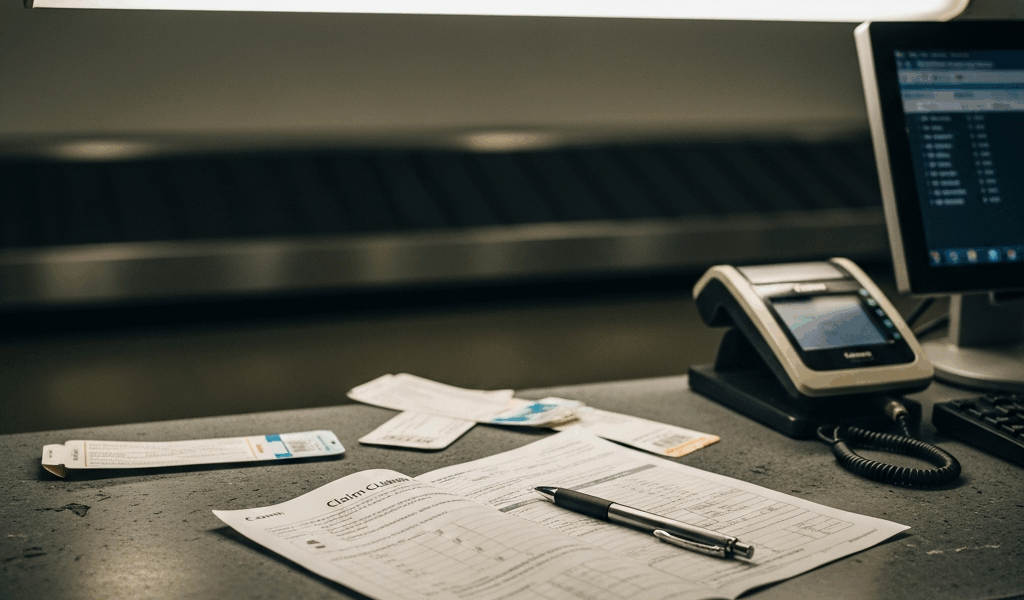
The agent produces a form — multi-page, printed or digital depending on the carrier. You describe the bag, confirm the intended destination, provide a contact address. You sign it. They hand you a copy with a reference number, usually starting with PIR followed by a string of digits. Write it down. Photograph it. Guard it like a passport.
Five to ten minutes, start to finish. That’s all this takes. Do not skip it.
What to Expect After You File the Report
Once the PIR is in the system, the airline enters your bag into their trace network. Baggage services starts actively searching — other airports, connecting flight holds, handling facilities, overflow bins that nobody checked in the moment. The system is surprisingly robust. Most bags are found within 24 to 48 hours.
You’ll typically hear something within the first 24 hours. Either the bag was located, or they’re still running it down. If found, they arrange delivery — directly to your hotel, your home address, wherever you specified. You don’t go back to the airport. United uses their own delivery network called UnitedDeliver. Others contract through FedEx or DHL. Either way, you get a tracking number.
Most major carriers — American, Delta, Southwest — have baggage trace tools on their websites where you can punch in your reference number and check status yourself. I’m apparently a compulsive checker and the American Airlines lookup tool works for me while calling the hotline never actually gets me useful information faster.
Set realistic expectations here: statistically, over 99% of delayed bags are eventually returned. Airlines have enormous financial incentives to find them — replacement costs are steep, liability is documented, and regulatory pressure is real. Your bag is almost certainly sitting somewhere specific. The systems exist to find it.
What Expenses the Airline Has to Cover
This is where airlines go quiet, and where most travelers end up paying out of pocket for things they were entitled to have reimbursed. That’s what makes this section the most important one for anyone who’s already filed the PIR and is now standing in a city without their luggage.
While your bag is delayed — not lost, just delayed — the Department of Transportation requires airlines to reimburse reasonable interim expenses on domestic flights. The EU requires the same under EC 261. “Reasonable” does heavy lifting in that sentence. A $200 designer jacket probably won’t fly. Basic underwear, socks, deodorant, a generic t-shirt from Target? Absolutely reimbursable.
Go buy what you actually need. A standard toiletries kit at CVS runs somewhere between $35 and $50 — toothbrush, toothpaste, travel shampoo, soap, deodorant. A change of clothes from any department store or chain retailer adds another $60 to $100 depending on where you shop. That $120 total is completely recoverable if you do this right.
Keep every receipt. The physical receipt — not just a photo. Some airlines want originals stapled directly to your claim form. Photograph them anyway for your own records, but hold onto the paper. You have a submission window of roughly 21 to 30 days depending on the carrier; the exact deadline is usually printed on your PIR copy. Miss that window and the reimbursement disappears entirely.
Submit to the airline’s baggage service office using your PIR number. Most carriers accept online submissions through their websites, or by email to the baggage claims department. Label everything clearly — dates, items, amounts. Make it easy for the person reviewing it to say yes.
When Your Bag Is Declared Lost and What to Do
Fourteen days pass and nothing. Some international carriers shorten that to five days. At that point, the airline officially declares the bag lost and contacts you to begin the formal claim process. This is a different conversation than interim expenses — this is full replacement value territory.
Documentation is everything now. They’ll want your baggage receipt, your PIR reference number, and a detailed itemized list of everything that was in the bag with estimated values. Not inflated guesses — realistic second-hand values. That winter coat you packed: $250. Toiletries and medications: $80. Three pairs of jeans at roughly $50 each: $150. Shoes, socks, phone charger, laptop accessories — add it all line by line. Take your time. The airline will push back on anything that looks exaggerated, and they’re experienced at spotting it.
There are liability caps. Domestic U.S. flights are capped at $2,500 per passenger under DOT rules. International flights cap at approximately $1,400 USD under the Montreal Convention. EU flights under EC 261 sit around €1,200. These are ceilings, not automatic payouts — you’re reimbursed for documented actual loss, up to the cap.
If they request proof of ownership, give them what you have — credit card statements, email receipts, purchase confirmations, anything tying you to the specific items. Photos from before your trip help enormously here. The review process typically runs four to eight weeks.
Claim rejected or settlement offer seems low? Escalate to the DOT if you’re in the U.S., or the relevant aviation authority in your country. Small claims court is a real option — most cases settle well before a hearing date, but filing demonstrates you’re serious. That changes the airline’s calculus pretty quickly.
How to Prevent This From Happening Next Time
So, without further ado, let’s dive into the part most people skip until they’ve already been burned once.
Put an Apple AirTag or a Tile Slim card inside your checked bag before it ever leaves your hands. AirTags are $29. Tile Slims are $25. You’ll track your bag in real-time, and if it ends up in Kansas City instead of Denver, you know immediately — before you’ve left the airport — instead of standing at a carousel watching everyone else leave. Most delayed bags are sitting somewhere specific, not truly lost. An AirTag tells you exactly where.
Photograph your bag and its contents before every trip. Open the suitcase, lay everything out flat, snap photos on your phone. This creates itemized proof of ownership that’s dated and timestamped. If you ever need to file a loss claim, this is worth more than almost anything else you can provide.
Carry the essentials in your carry-on — at least if you’re checking anything valuable. Medications, phone charger, one change of clothes, basic toiletries. Never check something you can’t survive 48 hours without. That’s the rule. It’s boring advice, but it’s the right advice.
Keep your baggage claim ticket somewhere you’ll find it — wallet, phone case, carry-on front pocket. Don’t throw it away at baggage claim out of habit. It’s a small slip of paper that becomes surprisingly important if the carousel empties out and your bag isn’t on it.
The vast majority of checked bags arrive exactly where they’re supposed to. The ones that don’t almost always turn up within two days. File the PIR the moment you realize there’s a problem, keep your receipts, and you’ll be fine.



Stay in the loop
Get the latest airport guides world updates delivered to your inbox.