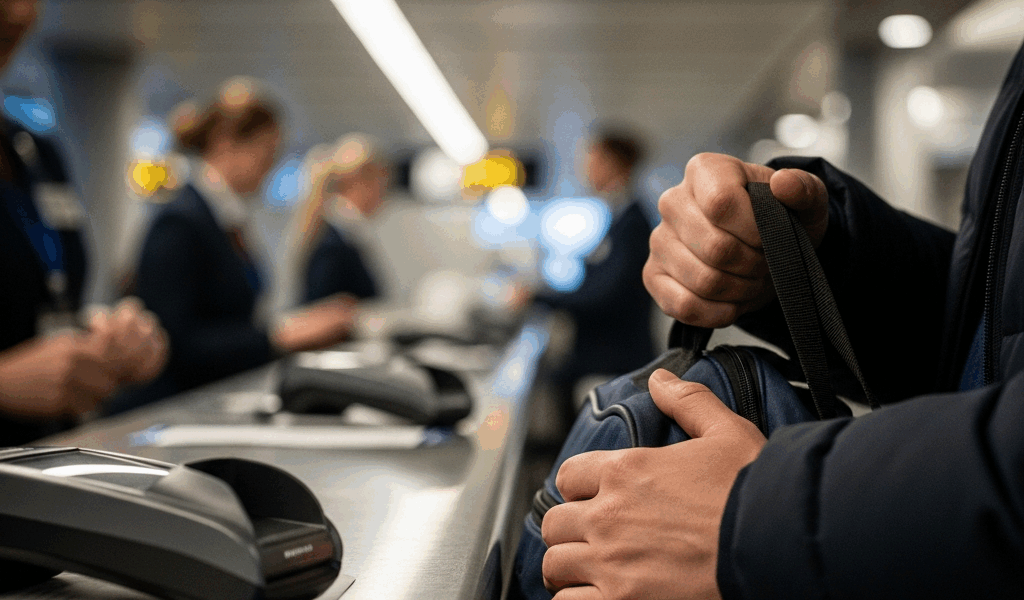
Why Airlines Gate Check Bags in the First Place
Gate checking has gotten complicated with all the misinformation flying around. So let me just cut through it: the overhead bins are full. Not metaphorically full. Physically, completely full. Regional aircraft — your CRJ-900s, your Embraer E175s — carry maybe 30 to 50 overhead spots for 70 to 80 passengers. Do that math yourself.
Gate agents know within the first 10 boarding groups whether the bins are going to run out. They’re not guessing. They’ve watched this exact scenario play out hundreds of times. When the announcement comes, it’s not a suggestion. It’s not a negotiation. The space is simply gone.
And honestly? It has nothing to do with how you packed. A standard rolling carry-on is permitted. So is your personal item. Both clear the dimension guidelines. The airline sold you a ticket — they’re supposed to get your bag on the plane. When they can’t, they gate check it. That means it skips the cabin entirely, goes into the cargo hold, and gets loaded at the gate itself rather than somewhere down the line at baggage claim.
What to Do the Second They Ask for Your Bag
The announcement hits. Your row number gets called. Your stomach drops. Here’s what you do — and you need to move fast, because gate agents work in seconds, not minutes.
- Do not hand over your bag immediately. Open it right there at the counter. Yes, in front of everyone. Yes, it feels awkward. Do it anyway.
- Remove medications, inhalers, and prescription items first. Gate-checked bags aren’t temperature-controlled. Insulin, blood thinners, EpiPens, anything temperature-sensitive — those go in your personal item or your pocket. The cargo hold can get extremely cold. Don’t gamble on that.
- Grab your laptop, tablet, and electronics. Put them in your personal item. Not because of theft — gate-checked bags are actually less likely to get pilfered than regular checked baggage — but because pressure changes and rough handling do real damage. I learned this firsthand when a MacBook Pro screen cracked during a connection through Denver. The gate agent had specifically told me to pull it out. I didn’t listen. Don’t make my mistake.
- Pull out jewelry, watches, and anything irreplaceable. Engagement rings, sentimental pieces, that vintage Seiko you’ve had for 15 years. Wear them. Pocket them. Stick them in your personal item. Ground crews handle gate-checked bags quickly — not carefully, just quickly. There’s a difference.
- Take any important documents with you. Passports, printed boarding passes, hotel confirmations — anything you’d genuinely panic about losing. Personal item or a carry-on pocket. Always.
- Ask the gate agent for a gate-check tag. Say exactly this: “Can you put a gate-check tag on this?” They’ll attach a barcode tag. That tag is your proof. Photograph it with your phone immediately, and try to get your flight number in the frame if you can.
- Ask one more question before you hand it over: “Will this come out planeside or at baggage claim?” Don’t assume. Aircraft types vary. Airline procedures vary. Knowing the answer upfront keeps you from standing at completely the wrong spot after landing — which is more common than you’d think.
That whole process takes 30 to 60 seconds. Gate agents are fast. Be faster with your decisions.
Is Your Bag Safe When It Gets Gate Checked
I’d rather tell you the truth here than hand you a comfortable non-answer.
Gate-checked bags fall under standard baggage liability. Lost bag, damaged bag — you file a claim exactly like you would for a regular checked bag. Domestic flights cap liability somewhere around $2,800 per bag depending on the carrier. United, American, Southwest — they all publish these limits. You can look them up in about 90 seconds.
What isn’t covered: fragile items, valuables, important documents, irreplaceable goods. That’s why you pulled them out in the previous section. A gate-checked bag does get loaded onto a cart. It does ride in the cargo hold. It does get jostled during loading and unloading. That’s just normal. Most bags come through completely fine.
But a ceramic mug will break. A laptop screen can crack. A vintage camera lens will shatter. The airline never agreed to protect those things — so there’s no compensation waiting for them. That’s the actual reason you remove them. Not paranoia. Policy.
Outright loss is genuinely rare. Gate-checked bags carry barcodes. The system tracks them. What you’re far more likely to run into is a delayed bag or minor cosmetic damage — a broken zipper pull, a scuff along the side panel, a cracked handle. Probably should have mentioned this earlier, honestly: that stuff happens with regular checked baggage too. It’s not a gate-checking problem specifically. It’s just airports.
Where to Pick Up Your Gate-Checked Bag After Landing
This is where most people get confused. You need to know which scenario applies before you even step off the plane.
Scenario One: Planeside Pickup
Some regional aircraft position the cargo hold door right near the jet bridge stairs. Your gate-checked bag comes out there — literally at the top of the stairs or at the gate threshold. Ground crew pulls bags out and stacks them. Yours should be in that pile. Grab it before you head inside. Some airlines announce this onboard. Listen for it. If you miss the announcement, ask a flight attendant before everyone stands up to deplane — just say “Are gate-checked bags coming out at the stairs?” They know. They do this route every single day.
Scenario Two: Baggage Claim Carousel
Other aircraft route gate-checked bags straight through the baggage system. You head down to baggage claim like normal. Your bag rides the carousel with everything else. It should still have the gate-check tag on it, but honestly, it looks like any other bag at that point. Watch the carousel for your airline’s flight number and stay focused.
International arrivals complicate this. Landing somewhere that requires customs inspection of checked baggage? Your gate-checked bag goes through customs baggage claim — not a separate planeside pickup, not the regular carousel. It follows the checked-bag path. It’ll be tagged, but it’s moving through the same system as every other checked bag on that flight.
Before you stand up to deplane — listen. Flight attendants announce pickup location. Write it down if you have to. Your brain is in full travel mode by that point. It won’t hold onto small details on its own.
What to Do If Your Gate-Checked Bag Is Damaged or Missing
It’s rare. Really rare. But it happens, so here’s exactly what to do.
If your bag hasn’t appeared within 15 minutes of the last checked bag coming off the carousel — or if you spot it at planeside pickup and it’s clearly damaged — file a report immediately. Not later. Not at home. Right there, before you leave the airport. Go directly to the airline’s baggage service desk.
Bring the gate-check tag photo, your boarding pass, any other documentation you have. Be specific about the damage — broken handle, torn fabric, missing wheel, whatever you’re looking at. The agent files a damage report or opens a lost-bag trace on the spot.
Gate-checked bags fall under identical liability coverage as regular checked bags. You can file a claim within the airline’s standard window — usually somewhere between 14 and 30 days depending on the carrier. The process is exactly the same as filing for a regular checked bag.
That’s what makes gate checking manageable for most travelers: it resolves faster than you’d expect. It’s routine procedure at busy airports and on smaller regional aircraft. Your bag will almost certainly land right alongside you. And if something does go sideways — you have the tag photo, the documentation, and a clear claims process. That’s how it works.




Stay in the loop
Get the latest airport guides world updates delivered to your inbox.