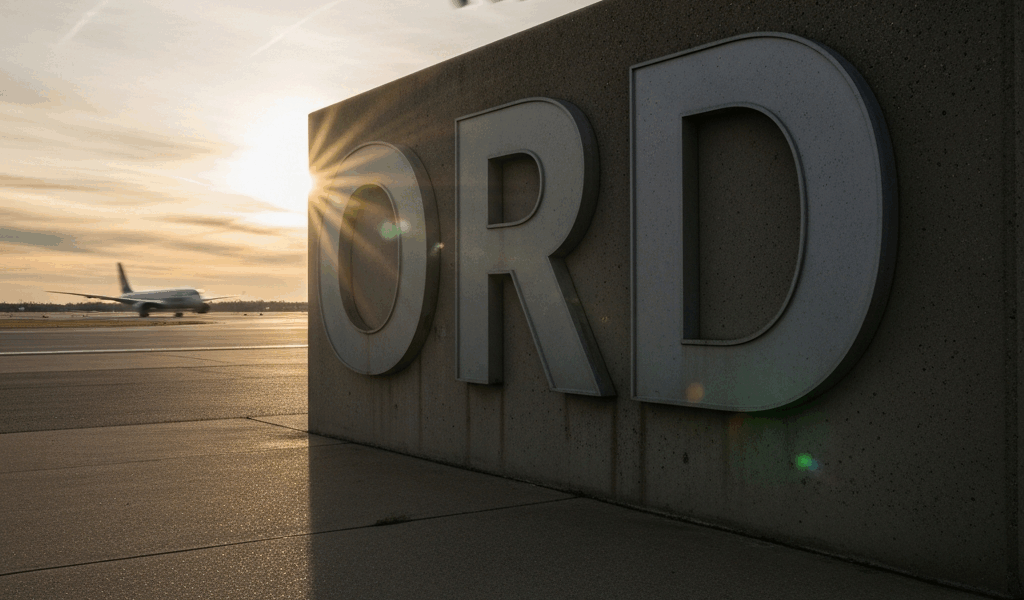
Why Is ORD the Airport Code for Chicago O’Hare?
The airport code for Chicago O’Hare is ORD — and if you’ve ever squinted at a baggage tag or a flight booking confirmation wondering what those three letters have to do with “O’Hare,” you’re not alone. I’ve been obsessed with airports and aviation history for most of my adult life, and the ORD code was one of the first mysteries that genuinely stopped me mid-thought. The airport is named O’Hare. The code is ORD. Those two things share exactly zero letters in common. There’s a real story behind that disconnect, and it reaches back to a World War II manufacturing plant, a Navy fighter pilot who became a national hero, and the bureaucratic inertia that kept a dead name alive on flight boards for decades.
Orchard Field — The Name Before O’Hare
Probably should have opened with this section, honestly, because this is where the whole thing starts to make sense.
Before Chicago O’Hare International Airport existed, the land it sits on — about 17 miles northwest of downtown Chicago — was home to something far less glamorous than one of the world’s busiest airports. During World War II, Douglas Aircraft Company operated a massive manufacturing plant on that site. They were producing the Douglas C-54 Skymaster, a four-engine transport aircraft that hauled troops, cargo, and critically important supplies across the Atlantic and Pacific theaters. The C-54 was the military workhorse version of the DC-4, and the Chicago plant was cranking them out at serious volume.
The area surrounding that plant was called Orchard Place. It was farmland, essentially — flat, open, ideal for the kind of large-footprint industrial operation Douglas needed. When a small airfield was developed on the site to support the manufacturing operation, it took the name from its surroundings. Orchard Field Airport. Simple, geographic, unremarkable.
When the International Air Transport Association began assigning two- and three-letter codes to airports during and after the war, Orchard Field got its code the straightforward way. O was already taken. OR was already taken in the existing system. So Orchard Field became ORD — the first two letters of “Orchard” plus a D as a disambiguating filler character, a common pattern you’ll see repeated across the industry. The airport opened to commercial traffic in 1945 after the military released it, and it operated as Orchard Field Airport, with the code ORD, until 1949.
Here’s where I made an embarrassing mistake when I first started researching this: I assumed ORD must stand for something aviation-specific, like some now-defunct regulatory designation. I spent a genuinely ridiculous amount of time down that rabbit hole before someone on an aviation forum pointed me back to the obvious answer — it literally just stands for Orchard. Sometimes the explanation is that clean.
The Douglas plant closed after the war ended. The farmland and airfield stayed. Chicago, recognizing that its existing airport — Midway, on the south side — was going to be overwhelmed by the coming surge in commercial aviation, began investing heavily in Orchard Field as its second major airport. The infrastructure grew fast. New terminals, new runways, expanded capacity. By the late 1940s, it was clear this place was going to be significant. Chicago decided it deserved a better name than a reference to a fruit orchard that no longer existed.
Butch O’Hare — The Medal of Honor Pilot
In 1949, Chicago renamed the airport after Edward Henry “Butch” O’Hare. If you’re not immediately familiar with that name, here’s the short version — and it’s genuinely one of the more remarkable individual combat stories to come out of World War II.
Butch O’Hare was a Navy fighter pilot. On February 20, 1942, he was flying an F4F Wildcat off the carrier USS Lexington in the Pacific. His squadron was scrambled to intercept a formation of Japanese Mitsubishi G4M bombers — nine of them — heading directly for the carrier. Due to a fuel situation, O’Hare’s wingman had to turn back. O’Hare kept going. Alone.
Fixated on protecting the Lexington, O’Hare made repeated attack runs on the incoming formation. He shot down five of the bombers. Five. By himself. In roughly four minutes of combat. He was running low on ammunition by the end of it — later examination of his gun camera footage showed he had been firing in short, disciplined bursts, conserving rounds to maximize effectiveness. That kind of precise thinking under that kind of pressure is almost impossible to overstate.
President Roosevelt personally awarded him the Medal of Honor. He became the first naval aviator to receive it during World War II. The country needed heroes in early 1942 — the news from the Pacific was grim, Midway hadn’t happened yet, and the whole arc of the war remained genuinely uncertain. Butch O’Hare was a real, tangible story about American skill and courage at a moment when those stories were desperately needed.
He died in combat in November 1943 during a night interception operation. He was 29.
Renaming Chicago’s rising new airport after him in 1949 was the kind of civic tribute that felt earned rather than ceremonial. The name O’Hare carried weight. But the airport code? The IATA wasn’t going to reassign it. Airlines had already built schedules, ticketing systems, and routing logic around ORD. Changing a code creates cascading paperwork and confusion throughout an entire industry. Nobody wanted that fight. So ORD stayed — the ghost of a wartime orchard, permanently attached to the name of a war hero who had nothing to do with orchards.
Other Airport Codes with Hidden Origins
Once you know the ORD story, you start noticing the pattern everywhere. Airport codes are a museum of renamed, relocated, and repurposed aviation history, and most travelers walk past the exhibits without even glancing up.
Take PDX — Portland International Airport in Oregon. The X at the end is a filler character, a common solution when all the logical two-letter combinations derived from a city or airport name were already claimed. Portland became PD, then PD needed a third character, and X is one of the least-used letters in the existing code system, making it a reliable filler. PHX, Phoenix Sky Harbor, follows the same logic. The X isn’t standing in for anything meaningful — it’s just a bureaucratic spacer that became a permanent identifier.
Then there’s MSY — Louis Armstrong New Orleans International Airport, which confuses people endlessly because Armstrong’s name offers no obvious path to those letters. MSY comes from Moisant Stock Yards. John Moisant was an early aviation pioneer who died in a crash near New Orleans in 1910 during an air meet. The land where the airport eventually developed was called Moisant Stock Yards — agricultural land, like Orchard Field, repurposed into aviation infrastructure. The airport got its code, the name changed, the code stayed. Sound familiar?
Intrigued by [the ORD story], I started cataloging airport codes with similar disconnects — cases where the current name and the IATA code come from completely different sources separated by decades of history. The list is long. EWR for Newark Liberty International traces back to early identifier systems for the city of Newark itself. MCO for Orlando International comes from McCoy Air Force Base, a Strategic Air Command installation that occupied the site before it became a civilian airport in the 1970s.
Each of those codes is a small piece of preserved history. A snapshot of what a place was called before it became what it is now. I find that genuinely fascinating — the idea that every time an airline agent prints a baggage tag to ORD, they’re accidentally referencing a Douglas C-54 production line that shut down in 1945.
This is the first in a series of airport code origin pieces on the site. If you’ve ever wondered why a code seems completely divorced from the airport it represents, there’s almost always a story worth knowing. Some of them are administrative accidents. Some are renamed wartime facilities. Some, like ORD, are both — carrying the echo of an old name while honoring something entirely different.
The three letters on your boarding pass have been there longer than you think.

Stay in the loop
Get the latest airport guides world updates delivered to your inbox.