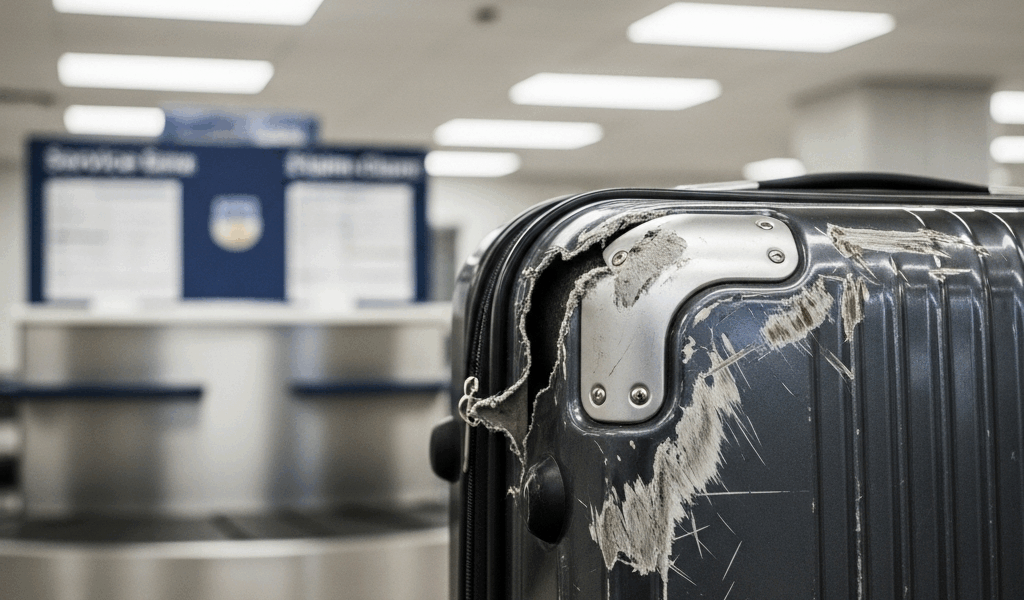
Stop — Do This Before You Leave Baggage Claim
Damaged luggage claims have gotten complicated with all the misinformation flying around. And honestly, most of it comes down to one decision you make in the next fifteen minutes — before you walk out of baggage claim.
As someone who learned this the absolute worst way possible, I now know everything there is to know about what to do when your bag is damaged at baggage claim. Today, I will share it all with you.
My roller bag came off the carousel with a dent the size of a grapefruit pressed into the side panel. Not catastrophic. Totally fixable. I grabbed it, shrugged, and headed toward ground transportation. Two weeks later I tried to file a claim. Denied. Outright. The reason? No Property Irregularity Report — a PIR — filed before I left the baggage claim area. That window had closed, and nobody warned me it existed.
Probably should have opened with this section, honestly.
Airlines don’t care that you didn’t know. Damage claims filed hours or days after landing get treated as suspect. The airline wasn’t there. They can’t verify anything. The entire precedent tilts in their favor the second you exit that terminal.
So here’s what you do: go straight to the airline baggage desk before you leave baggage claim. It’s usually near the carousel where your bag arrived, or just outside the secured area — look for signage or flag down any airport employee. Tell them your bag is damaged. They’ll have you fill out a PIR right there or walk you to a back office where staff will document everything formally. That’s it. You’re now on record, timestamped, with a report number proving the damage was flagged before you left the building.
The PIR itself is a simple form. Name, flight details, baggage tag number, damage description. The rep may photograph the bag themselves or ask you to provide photos. Either way — twelve minutes. Maybe fifteen. That’s the difference between approved and denied.
How to Document the Damage on the Spot
Before you even approach the airline desk, pull out your phone and photograph everything. This is your evidence. Quality matters here.
Shoot the damage from multiple angles. Broken wheel? Get close-ups from the side and underneath. Shell crack? Photograph it with flash, then without. Torn zipper or bent handle? Those too. Then — and this part matters — photograph the undamaged sections of the bag. That’s your counter-argument if the airline tries to claim the damage was pre-existing. If the bag contents were affected, open it up and photograph those as well.
Next, get a single frame with both your baggage tag and your boarding pass together. That one photo links the bag directly to your flight, beyond any reasonable doubt.
Back up those photos immediately. Cloud storage, email them to yourself, whatever — do it before you leave the airport. I’ve seen travelers lose their phones three days after a trip and lose every bit of documentation with it. Don’t make my mistake.
Dig out the original receipt for the bag if you can find it. Most major luggage brands — Samsonite, Away, Rimowa, American Tourister — sell through email-receipt retailers, so check your inbox. A damaged $180 carry-on isn’t treated the same as a damaged $480 spinner. That model number and purchase price will matter later if things escalate.
Filing a Damage Claim With the Airline
You have two paths here. They’re not mutually exclusive — run both simultaneously if you can.
Path one is the in-person PIR you’ve already filed. The airline rep hands you a copy with a report number. Ask for a printed copy and an email confirmation before you leave that desk. Some airlines send both automatically. Others send nothing. Don’t assume.
Path two is the online claim portal. United, American, Delta, Southwest, JetBlue, Alaska — they all have baggage claim portals. Log in, reference your flight and baggage tag, upload your photos. The portal asks for damage description, travel date, and an itemized list of any damaged contents. File within 48 hours of landing. Don’t wait on this.
But what about the actual rules airlines follow? In essence, it depends on whether your flight was international or domestic. But it’s much more than that. Under the Montreal Convention — which covers most international routes — airlines have seven calendar days to respond to damage claims. Domestic US flights fall under DOT regulations, where the standard window stretches to 21 days for initial response, though airlines routinely take longer. Your claim doesn’t have to be resolved in that window. If they don’t acknowledge it, you have grounds for escalation.
What Airlines Are Actually Required to Cover
Airlines love excluding things. It’s basically a sport for their legal teams.
Under the Montreal Convention, international carriers are liable for baggage damage up to roughly $1,700 USD — the exact number shifts slightly with exchange rates. Domestic US flights have no hard cap, but the DOT expects reasonable compensation based on fair market value. That phrase does a lot of heavy lifting.
What they won’t cover: pre-existing damage, overpacking that caused structural failure, and fragile items in soft luggage. Packed a laptop without a hard case? The airline will argue it wasn’t adequately protected. Stuffed a bag so full the zipper split under pressure? That becomes negligent packing, not mishandling. They’ll push that angle hard.
What they will cover: broken wheels, bent frames, torn zippers from handler mishandling, impact damage from conveyor systems, cargo loading damage. That’s squarely airline responsibility — at least if you have documentation proving the bag was fine when you checked it.
Valuation is where most disputes happen. The airline offers a percentage of original purchase price, not replacement cost. That’s standard. A three-year-old Samsonite spinner that cost $200 new might get valued at $80 after depreciation is applied. Frustrating? Yes. Legal under most policies? Also yes.
If the Airline Denies or Lowballs Your Claim
You have options. Use them.
DOT complaint portal — if a US airline denies your claim unfairly, file a formal complaint with the Department of Transportation. You’ll need your denial letter and all your documentation. The DOT can apply pressure, though direct enforcement on damage claims is limited. It still works more often than people expect.
Credit card chargebacks — I’m apparently someone who puts every travel purchase on an Amex, and that approach works for me when airline portals never do. If you bought the bag on a credit card, dispute the charge. Include the damage photos, the PIR, the denial letter. Card issuers have leverage airlines respect. No proof of satisfaction from the airline, no payment release.
Travel insurance — if you had baggage protection through a travel insurance policy or a premium card, file with them instead. Approval timelines are typically faster, and liability limits sometimes exceed what airlines offer directly. Worth running parallel to your airline claim.
Small claims court — this sounds dramatic. It isn’t. Many travelers win these cases because judges view airline denials skeptically when solid documentation exists. Most jurisdictions handle claims up to $5,000–$10,000. You’ll bring your PIR, your photos, and your original receipt. That’s usually enough.
While all of this unfolds, buy a replacement bag if you’re still traveling. Major airports have luggage options — Duty Free shops, travel goods stores, Target at some larger terminals. A functional carry-on runs $60–$120. Keep the receipt. You can request interim reimbursement from the airline while your claim processes. They’ll offer less than you paid. Ask anyway — it sometimes works, and that money adds up.



Stay in the loop
Get the latest airport guides world updates delivered to your inbox.