Who Invented Rolling Luggage? The Surprisingly Recent Story
The Answer — Robert Plath, 1987
Who invented rolling luggage? The answer is Robert Plath, a Northwest Airlines pilot, who created the modern rolling suitcase in 1987. That’s it. That’s the answer. If you’re in a hurry, go ahead and close the tab — but you’d be missing the part that actually makes this story worth knowing, which is why it took until 1987, and why flight attendants were quietly using this thing for years before the rest of the world caught on.
I’ve spent a lot of time in airports — more than I’d care to count — and I remember genuinely assuming that rolling luggage had existed since, I don’t know, the 1950s at least. The postwar jet age, businessmen in suits, surely someone had thought of this. Nope. The Rollaboard, which is the actual trademarked name Plath gave his invention, is less than 40 years old. Your parents almost certainly traveled without one as adults. That still gets me.
Plath didn’t stumble into this accidentally. He was a working commercial pilot, logging long days through airport terminals, dragging heavy bags the same way everyone else did. The insight he had wasn’t complicated. But nobody had acted on it yet.
Why It Took So Long — The Luggage Problem Before 1987
Here’s where I should probably clarify something, because I got this wrong the first time I looked into it. Wheels on luggage did exist before 1987. Bernard Sadow, a luggage executive, patented a wheeled suitcase back in 1970. The patent number was 3,653,474 if you want to look it up — and it’s worth looking up, because the design is almost comically impractical by modern standards.
Sadow’s bag lay flat and rolled on four wheels mounted to the bottom, pulled by a loose strap attached to the top. You dragged it behind you like a reluctant dog on a leash. The bag flopped and wobbled. It had no structural rigidity when moving. And critically, it was heavy to load because you were bending over a horizontal bag to pack it. Department stores carried it — Macy’s was an early retailer — but travelers didn’t exactly embrace it with enthusiasm.
The engineering insight Plath had in 1987 was deceptively simple: orient the bag vertically, mount two wheels on the bottom edge, and attach a long retractable handle to the top so the traveler could pull it upright like a hand truck. Instead of pushing a low, floppy bag or hauling a strap attached to a horizontal one, you walked normally and the bag followed behind you, balanced on its edge.
Obvious in hindsight. Almost embarrassingly obvious.
So why did it take 17 years from Sadow’s 1970 patent to Plath’s 1987 prototype? Partly manufacturing inertia — the luggage industry was not exactly a hotbed of radical rethinking. Partly because the extendable aluminum handle was harder to engineer cheaply than it looks. And partly, I suspect, because no one who spent enough time in airports was also in a position to do something about it. Plath was. He had the engineering inclination, the daily firsthand frustration, and eventually the garage workshop time to prototype something real.
Flight Attendants Were First — Then the World Followed
Frustrated by the same heavy bags he and his colleagues were hauling through terminals every day, Plath built his first prototype in his garage in Coconut Creek, Florida, sometime around 1987. The initial design used a two-wheel configuration with an aluminum handle that telescoped out from the bag’s spine — the exact format you’d recognize instantly today.
He started making them for fellow crew members. Word spread fast through the Northwest Airlines base, then outward through the broader flight crew networks that connected airline employees across carriers. Here’s the thing about pilots and flight attendants as an early-adopter group: they are in airports constantly, they travel on tight turnarounds, and they are brutally practical about gear. If something makes the job easier, they find out about it within weeks, not years.
Plath founded TravelPro International in 1989 to manufacture and sell the bags commercially. The flagship product was called the Rollaboard — a name that became so associated with the category that it functions almost like a generic term now, the way Kleenex does for tissues. Early TravelPro bags were priced around $150 to $200, which wasn’t cheap in 1989 dollars, but for flight crew using luggage professionally and daily, it was an easy sell.
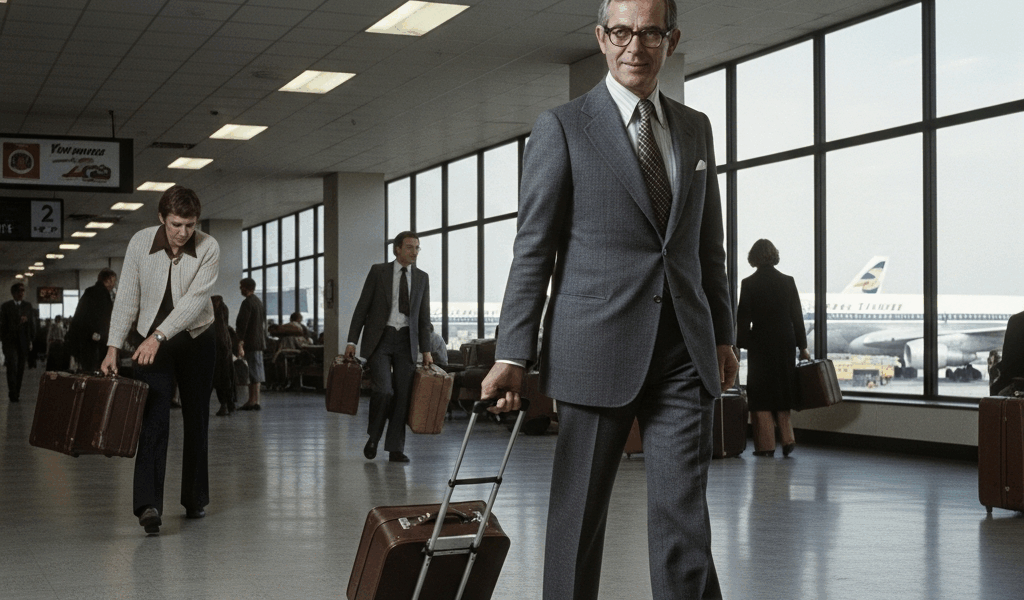
For roughly the first three to four years, the Rollaboard was primarily crew luggage. Walk through an airport in 1990 or 1991 and you’d see flight attendants rolling their bags purposefully through the terminal while regular passengers wrestled shoulder bags and boxy hard-sides. Probably should have opened with this section, honestly, because this is the part people find most surprising — the technology existed and was in daily use in airports for years before it reached the general public.
The crossover happened gradually in the early 1990s. Leisure travelers noticed what crew members were using. Business travelers — already sensitized to the misery of checked baggage fees and carousel waits — started asking where to buy one. Travel retailers picked up the product. By around 1993 or 1994, the Rollaboard had broken well past the flight crew niche and was becoming mainstream.
One personal lesson I took from researching this: I’d always vaguely assumed that consumer products reach regular people first, and professionals adopt them later. Usually true for phones, software, kitchen gear. The Rollaboard ran the exact opposite direction — professionals in a specific environment got it first, and the rest of the market followed their lead once they saw it in action. Sometimes the best product research is just watching who’s already doing the job.
From Patent to Every Brand on Earth
Plath held patents on the Rollaboard design, which gave TravelPro a meaningful competitive window in the early 1990s. The core utility patent covered the specific upright-with-retractable-handle configuration. Patent protection on utility patents in the US runs 20 years from the filing date — once those protections expired, the entire luggage industry moved in.
Samsonite, Rimowa, Travelpro’s own competitors, every off-brand manufacturer in Guangdong province — within a few years of key patents expiring, the two-wheel inline rollerbag was the default luggage format for essentially the entire market. The design was simply too useful not to copy at scale once the legal pathway was clear.
The next significant engineering evolution came with spinner wheels — four multidirectional wheels mounted on the bag’s corners rather than two inline wheels on the bottom edge. Spinner-style bags roll in any direction without tilting, which makes them easier to manage in tight spaces like airplane aisles and overhead-bin staging areas. The tradeoff is that spinners sit slightly less stable on inclined surfaces and add a small amount of weight. The inline two-wheel design Plath originally built still has its advocates among frequent travelers for exactly that reason — simpler mechanism, lighter, tracks straight.
TravelPro is still operating, still headquartered in Boca Raton, Florida, and still markets heavily to flight crew. Their Crew series remains one of the more recognizable products in the airport-crew niche, priced in the $250 to $450 range for carry-on sizes as of recent years. The company that started in a garage in Coconut Creek turned into a durable mid-market brand — not the flashiest outcome, but a legitimate one.
Robert Plath’s invention was, at its core, a small mechanical reorientation of an existing idea. Vertical instead of horizontal. Pull instead of push. Rigid handle instead of a floppy strap. The concept took about 30 seconds to explain and changed how nearly every person on the planet travels. That’s a pretty good garage project.




Stay in the loop
Get the latest airport guides world updates delivered to your inbox.